
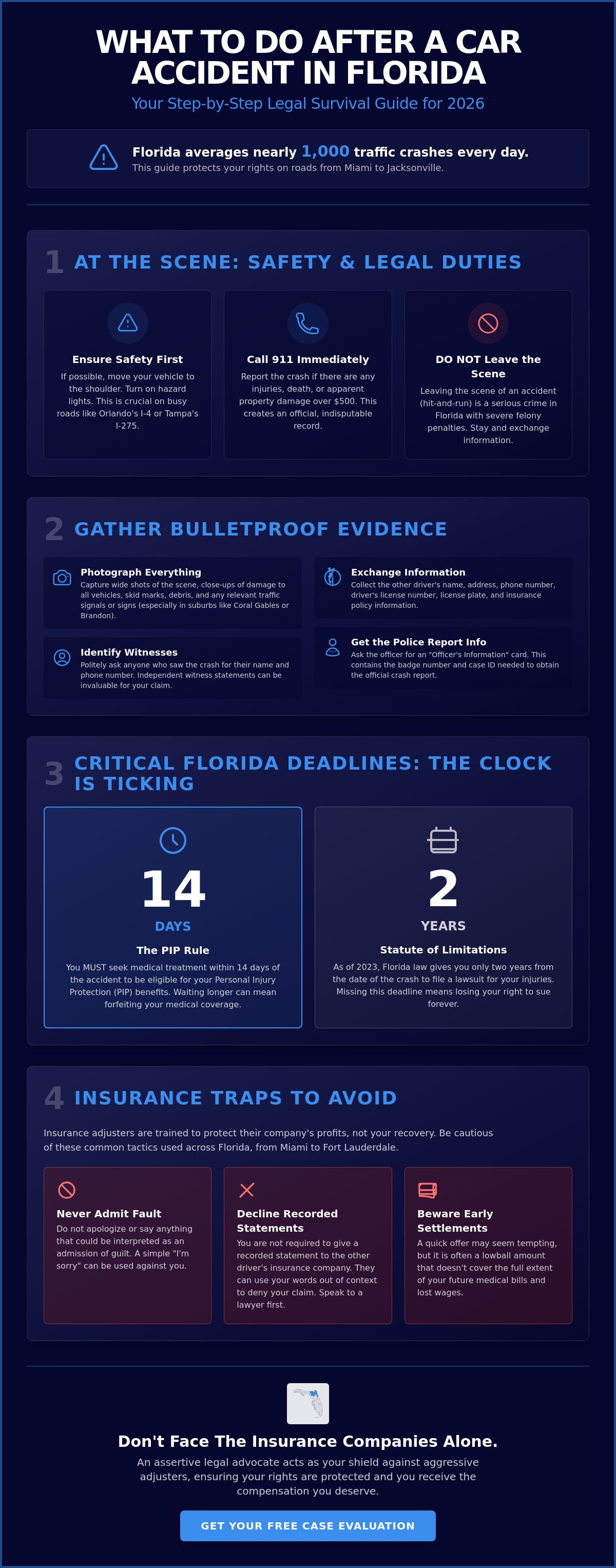
Did you know that in 2025, Florida averaged nearly 1,000 traffic crashes every single day? From the congested intersections of Miami and Fort Lauderdale to the high-speed corridors of Orlando and Tampa, the risk on our roads is constant. If you are reading this, you are likely facing the immediate chaos and confusion of a collision. You are probably searching for what to do after a car accident in Florida while juggling physical pain and the fear of mounting medical debt. It is exhausting to deal with aggressive insurance adjusters who call your phone before you have even had a chance to see a doctor.
We understand that you feel targeted by a legal system that often prioritizes corporate profits over your personal recovery. This 2026 legal survival guide acts as your shield. It provides an expert-led, step-by-step breakdown of your requirements under current state law to ensure your rights remain intact. You will learn how to navigate the critical 14-day PIP rule and the shortened two-year statute of limitations with total confidence. We are going to detail the exact actions you must take to secure your financial future across every suburb and metropolitan area in the Sunshine State.
Key Takeaways
- Understand your immediate legal obligations at the scene to avoid severe criminal penalties on Florida's busiest highways and thoroughfares.
- Learn how to capture bulletproof evidence, including vehicle positions and property damage, to protect your claim in cities like Miami, Tampa, and Orlando.
- Discover exactly what to do after a car accident in Florida to meet the critical 14-day PIP deadline and unlock your full medical benefits.
- Identify common insurance company traps, such as early settlement offers and recorded statements, designed to devalue your recovery.
- See how an assertive legal advocate acts as a shield for residents in Jacksonville and across the state against aggressive insurance adjusters.
Immediate Scene Safety and Legal Obligations in Florida
The seconds following a crash are a blur of adrenaline and fear. On high-speed corridors like I-4 in Orlando or I-95 in Jacksonville, that initial confusion can be deadly. Your immediate priority is physical safety. If your vehicle is operable, move it to the nearest shoulder. Staying in a live lane of traffic invites a secondary traffic collision, which is often more severe than the first impact. Once you are clear of the flow of traffic, stay at the scene. Florida hit-and-run laws carry severe criminal penalties that can transform a civil matter into a life-altering felony. You must remain present to exchange information and fulfill your legal duties.
Under Florida Statute Section 316.062, you have a legal mandate to provide reasonable assistance to anyone injured. Check yourself and your passengers immediately. If there is any physical pain, significant vehicle damage, or if the wreckage blocks traffic, call 911. Don't wait for the other driver to make the call. This initial contact is the first step in documenting what to do after a car accident in Florida to protect your future claim. An official dispatch record creates a timestamp that insurance companies cannot easily dispute later.
The $500 Reporting Rule (Section 316.065)
Florida law is clear under Section 316.065. You must report a crash to law enforcement if it results in injury, death, or property damage of $500 or more. In 2026, even a minor bumper scuff on a modern vehicle with sensors and cameras easily exceeds this $500 threshold. Never accept a "handshake" agreement to skip the police. Without an official report, you lose the foundational evidence needed to fight aggressive insurance adjusters. Self-reporting later is often viewed with suspicion by insurers and can jeopardize your right to compensation.
Securing the Crash Site in Metro Areas
In dense metro areas like Miami or Tampa, a crash site is a chaotic and dangerous environment. Activate your hazard lights immediately and use flares if you have them in your emergency kit. When you interact with the other driver, remain polite but guarded. Never apologize. In the eyes of a legal adversary, a simple "I'm sorry" is a recorded admission of fault. We act as your shield against these interpretations, but your silence at the scene is your first line of defense.
Manage the "shock factor" carefully. Adrenaline often masks serious internal injuries or soft tissue damage. You might feel "fine" at the scene in the heat of the moment, but declining an ambulance can be a costly mistake for your health and your case. If a paramedic suggests transport, take it. Your physical recovery is the priority; the legal battle comes next. Knowing what to do after a car accident in Florida starts with recognizing that your body is in shock and needs professional medical evaluation immediately.
Gathering Bulletproof Evidence for Your Florida Claim
Evidence is the lifeblood of your recovery. Without it, your case is just your word against theirs. In the high-stakes environment of a Florida insurance claim, documentation acts as a fortress around your rights. You must act quickly. Take your phone and record everything. Start with wide-angle shots showing the entire intersection or stretch of road. Then, move in for close-ups. Capture the paint transfer, the shattered glass, and the specific position of the vehicles before they are moved. These details are the foundation of what to do after a car accident in Florida to ensure you aren't left paying for someone else's mistake.
Don't forget the ground. Skid marks tell a story of speed and reaction times that a driver might try to deny later. Look up at the traffic signals. If a light was malfunctioning or obscured by overgrown foliage in a suburb like Coral Gables or Brandon, that detail is critical. While you are documenting the scene, look for bystanders. Witnesses often leave as soon as the sirens fade. Get their names and phone numbers immediately. When the police arrive, ensure you receive an "Officer's Information" card. This card contains the badge number and the case ID, which are essential for following Florida's crash reporting requirements and obtaining the final report.
Leveraging Local Metropolitan Resources
In areas like downtown Orlando or the suburbs of Jacksonville, you aren't limited to your own photos. Many intersections are monitored by municipal traffic cameras or private security systems. However, this footage is often overwritten within days. You need to identify these sources fast. If your accident happened on a state road, the Florida Highway Patrol typically handles the report. If it occurred within city limits, local agencies like the Jacksonville Sheriff's Office will be your point of contact. Dashcam footage is another game-changer. In multi-lane collisions on the Palmetto Expressway or I-275, a dashcam provides the objective truth that settles liability disputes instantly.
Personal Documentation and Injury Logs
Your body is evidence too. Photograph visible injuries like bruising, cuts, or swelling as they develop. These images provide a visceral timeline of your suffering. Sit down as soon as possible and write a "memory dump." Record what you saw, heard, and felt. Did the other driver look distracted? Did they smell like alcohol? Keep this log private. A common trap is posting updates on social media. Insurance adjusters scan your profiles for any reason to devalue your claim. A single photo of you smiling at a family dinner can be used to argue you aren't truly injured. If you're unsure how to manage these risks, seeking expert car accident legal representation can prevent these costly mistakes. Knowing what to do after a car accident in Florida means protecting your digital footprint as fiercely as your physical health.
The 14-Day PIP Rule: Florida's Most Critical Deadline
The clock starts ticking the moment of impact. Whether you were rear-ended on I-4 in Orlando or side-swiped in a Jacksonville suburb, you have exactly 14 days to seek medical treatment. This is a non-negotiable legal requirement. If you miss this window, your Personal Injury Protection (PIP) carrier will deny your claim entirely. This rule exists to benefit insurance giants, not the victims. They bank on the fact that many people wait for the pain to "just go away" before seeing a doctor. Don't fall into this trap. Your right to compensation depends on your speed.
Delayed symptoms are a dangerous reality. Conditions like whiplash or a Traumatic Brain Injury (TBI) don't always manifest while you're standing on the shoulder of I-95. You might feel "fine" in the heat of the moment, but three days later, the migraines, neck stiffness, and cognitive fog become unbearable. Seeking immediate care at an ER or urgent care is the most vital step in what to do after a car accident in Florida. It creates a medical paper trail that links your injuries directly to the crash, leaving no room for adjusters to claim your pain was pre-existing. According to the Insurance Information Institute, having a clear plan for medical documentation makes the entire claims process significantly easier and more effective.
To unlock your full $10,000 in PIP benefits, a medical professional must diagnose you with an "Emergency Medical Condition" (EMC). Without this specific designation, your coverage is capped at a mere $2,500. This is a massive $7,500 gap that leaves you vulnerable to mounting debt. We act as your shield by ensuring you understand these requirements before the insurance company tries to shortchange your recovery.
The 'No-Fault' Insurance Myth Debunked
Florida is a "no-fault" state, but that's a misleading title. It doesn't mean no one is responsible for the wreckage. It simply means your own insurance pays for your initial treatment regardless of who caused the crash. However, PIP isn't a catch-all. It only covers 80% of medical bills and 60% of lost wages. You're still responsible for the remaining balance. To recover those losses or seek damages for pain and suffering, you must step outside the no-fault system and hold the negligent party accountable. This is only possible if your injuries meet the "serious injury" threshold defined by state law.
Choosing the Right Medical Provider
Don't be surprised if your primary care doctor refuses to see you. Many general practitioners in Florida don't handle car accident cases because of the complex PIP billing and documentation rules. You need specialists who understand what to do after a car accident in Florida to protect a legal claim. Maintaining a consistent treatment plan is essential. Even a small "gap" in care gives adjusters an excuse to argue you've recovered. We help you stay focused on your healing while we handle the aggressive tactics of the insurance companies.
Navigating Insurance Tactics and Avoiding Common Traps
Within hours of a collision in Hialeah or St. Petersburg, your phone will ring. The caller will sound sympathetic. They will ask how you are feeling. Do not be fooled. This insurance adjuster is a trained negotiator whose sole mission is to devalue your suffering and protect their company's bottom line. They are looking for any slip of the tongue to use against you. Understanding what to do after a car accident in Florida means recognizing these calls for what they are: a strategic strike against your future recovery.
The "Recorded Statement" is their most dangerous weapon. They will tell you it's just to "get your side of the story." In reality, they use leading questions to trap you into admitting fault or downplaying your physical pain. Never provide a recorded statement without an attorney present. Similarly, be wary of early settlement offers. These "quick cash" checks are designed to make you go away before you realize the true extent of your medical needs. Once you sign that release, you're barred from seeking further compensation, even if your injuries require surgery months later. They also want you to sign a broad medical authorization form. Don't do it. This gives them access to your entire health history, allowing them to claim your current pain is actually a "pre-existing condition" from years ago.
Adjusters are also digital hunters. They will monitor your social media profiles in suburbs like Boca Raton or Brandon. A single photo of you smiling at a family barbecue can be twisted to argue that you aren't truly injured. Your silence is your shield. Keep the details of your crash and your recovery off the internet entirely.
Communicating with Your Own Carrier
You have a contractual duty to cooperate with your own insurance company, but that doesn't mean you have to surrender your rights. You must report the accident, but you don't have to discuss liability or the specifics of your injuries until you've spoken with a professional. Before you sign any document that could strip away your legal standing, consult a personal injury lawyer near me to understand the full weight of your signature. Reporting the facts of the crash is mandatory; providing a narrative that could jeopardize your claim is not.
Dealing with the At-Fault Driver's Insurance
The other driver's insurance company owes you nothing. They will use Florida's modified comparative negligence rule to shift blame onto you. If they can convince a court that you are 51% or more at fault, they are legally barred from paying you a single cent. Aggressive representation is the only way to counter these big-firm tactics. We act as a seasoned warrior in this struggle, ensuring that blame isn't unfairly shifted to you. If you want to stop the harassment and secure a fair outcome, you need determined car accident legal representation to take over the communication. Knowing what to do after a car accident in Florida means letting a professional handle the adjusters while you focus on your physical recovery.
Why Fenderson Law is Your Shield for Justice
Are you tired of being treated like a claim number by insurance giants? In the wake of a crash, you need more than just advice; you need a shield. Insurance companies employ teams of lawyers and adjusters who work around the clock to protect their corporate profits. You deserve a warrior who fights just as hard for your recovery. At Fenderson Law, we provide the aggressive advocacy required to level the playing field. Whether you are navigating the aftermath in Jacksonville, Orlando, Tampa, or Miami, we stand as your determined protector. We handle the aggressive adjusters and the complex paperwork so you can focus entirely on your physical healing. Knowing what to do after a car accident in Florida is only half the battle; the other half is having a seasoned ally who refuses to back down.
Our firm stays ahead of Florida's specific 2026 statutes and evolving court procedures. We ensure your claim is never derailed by a technicality or a missed deadline. We know the traps adjusters set, such as the predatory recorded statement requests and the lowball early settlement offers. We step in to stop the harassment immediately. Best of all, we offer a no-fee guarantee. We only get paid when we recover money for you. This commitment makes elite legal representation accessible to every victim, regardless of their current financial hardship. We believe that justice should never be a luxury.
Our Regional Expertise and Reach
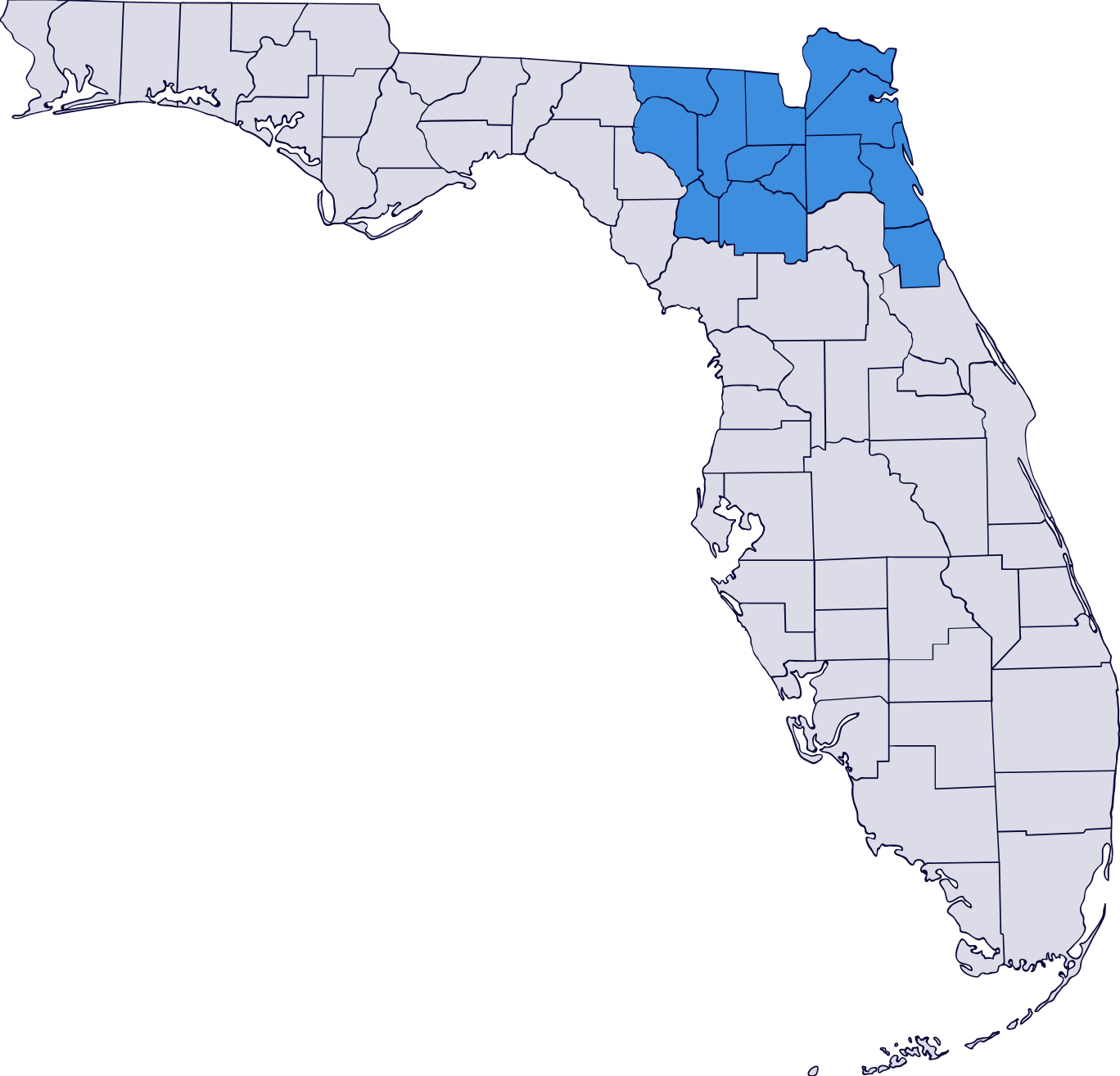
From the high-speed collisions on I-95 in Duval County to the congested intersections of Miami-Dade, our regional knowledge is your greatest asset. We understand the specific hazards of Florida's most dangerous suburbs and metropolitan hubs. This expertise is vital in the most complex litigation, such as cases requiring a florida truck accident lawyer. We are committed to every resident across the state. Whether you are in Tallahassee, Gainesville, Fort Myers, or West Palm Beach, our reach is omnipresent. No distance is too far to ensure a fair outcome for our clients.
Your Next Steps: The Free Consultation
Taking the first step toward recovery shouldn't be a source of stress. When you meet with T. Charles Fenderson for your initial consultation, bring your accident report, medical records, and any evidence you gathered at the scene. We will use these details to calculate the true value of your claim, accounting for your current medical debt and your long-term rehabilitation needs. Don't let another day pass while insurance companies build a case against you. If you are unsure what to do after a car accident in Florida, let us provide the clarity you need. Contact Fenderson Law Firm for a Free Consultation today. We are ready to act as your shield and secure the justice you deserve.
Take Command of Your Legal Future
The road to recovery after a crash is paved with strict deadlines and aggressive insurance tactics. You now understand that the 14-day PIP medical window is non-negotiable and that your silence is your greatest weapon against predatory adjusters. From the bustling streets of Tampa to the quiet suburbs of Jacksonville, the steps you take today define your financial security for years to come. Knowing what to do after a car accident in Florida is the difference between being a victim of the system and a victor in the courtroom.
You don't have to face this struggle alone. T. Charles Fenderson provides the specialized car, truck, and motorcycle accident representation you need to win. With over 15 years of aggressive Florida advocacy, our firm acts as your shield against powerful entities that want to devalue your pain. We offer a no recovery, no fee guarantee because we believe your path to justice should be clear of financial obstacles. It's time to stop the harassment and start your healing process with a seasoned warrior by your side.
Get Your Free Case Evaluation with Fenderson Law Firm
You've survived the impact; now let us help you survive the legal aftermath. Stand tall, stay focused on your recovery, and let us fight for the compensation you deserve.
Frequently Asked Questions
How long do I have to file a car accident lawsuit in Florida?
You have exactly two years from the date of the crash to file a personal injury lawsuit. This is a strict deadline that was recently shortened from the previous four year limit. If you miss this window, you lose your right to hold the negligent party accountable in a Florida court. We act as your shield to ensure every filing is completed with precision before time runs out.
What happens if the other driver doesn't have insurance?
If the at-fault driver is uninsured, you must rely on your own Uninsured Motorist (UM) coverage if you have it on your policy. Since Florida has some of the highest rates of uninsured drivers in the nation, this coverage acts as your vital safety net. Your mandatory PIP will also cover initial medical costs regardless of the other party's insurance status. We fight to maximize every available resource for your recovery.
Can I still get compensation if I was partially at fault for the crash?
You can recover damages as long as you are found to be 50% or less at fault for the accident. Under Florida's modified comparative negligence rule, your compensation is reduced by your specific percentage of fault. However, if you are 51% or more responsible, you are legally barred from recovering any money from other parties. Our aggressive advocacy works to minimize your fault percentage to protect your payout.
Is it worth hiring a lawyer for a minor car accident in Florida?
Yes, because even seemingly minor accidents can result in chronic pain or hidden vehicle damage that exceeds the $500 reporting threshold. Insurance adjusters are trained to minimize small claims to save their employers money. A lawyer ensures you don't overlook the long term costs of whiplash or soft tissue injuries that manifest days after the impact. We treat every case with the urgency it deserves.
What should I tell my insurance company right after the accident?
Provide only the objective facts such as the date, time, and location of the collision. Do not speculate on fault or give a detailed description of your injuries until you have received a professional medical evaluation. Knowing what to do after a car accident in Florida involves protecting your claim by refusing to provide a recorded statement during that initial call. Let us handle the communication to avoid their traps.
What does 'No-Fault' state actually mean for my medical bills?
Being a No-Fault state means your own Personal Injury Protection (PIP) insurance pays for your medical bills first, regardless of who caused the wreck. It typically covers 80% of your medical expenses and 60% of lost wages up to a $10,000 limit. To recover the remaining 20% or seek money for pain and suffering, you must file a claim against the at-fault driver's insurance. We navigate these overlapping layers of coverage for you.
How do I get a copy of my Florida traffic crash report?
You can obtain your official report through the Florida Department of Highway Safety and Motor Vehicles (FLHSMV) online portal or by visiting the local precinct that responded. Whether it was the Jacksonville Sheriff's Office or the Miami Police Department, you will need the case ID number provided by the officer at the scene. This document is a foundational piece of evidence that we use to build your case for justice.
Will my insurance rates go up if the accident wasn't my fault?
Florida law generally prohibits insurance companies from raising your premiums if you were not substantially at fault for the accident. Under Section 626.9541, carriers cannot impose a surcharge for an accident where you were not the primary cause. If you are struggling with a carrier that ignores what to do after a car accident in Florida guidelines regarding rate hikes, our firm provides the determined protection you need to hold them accountable.


