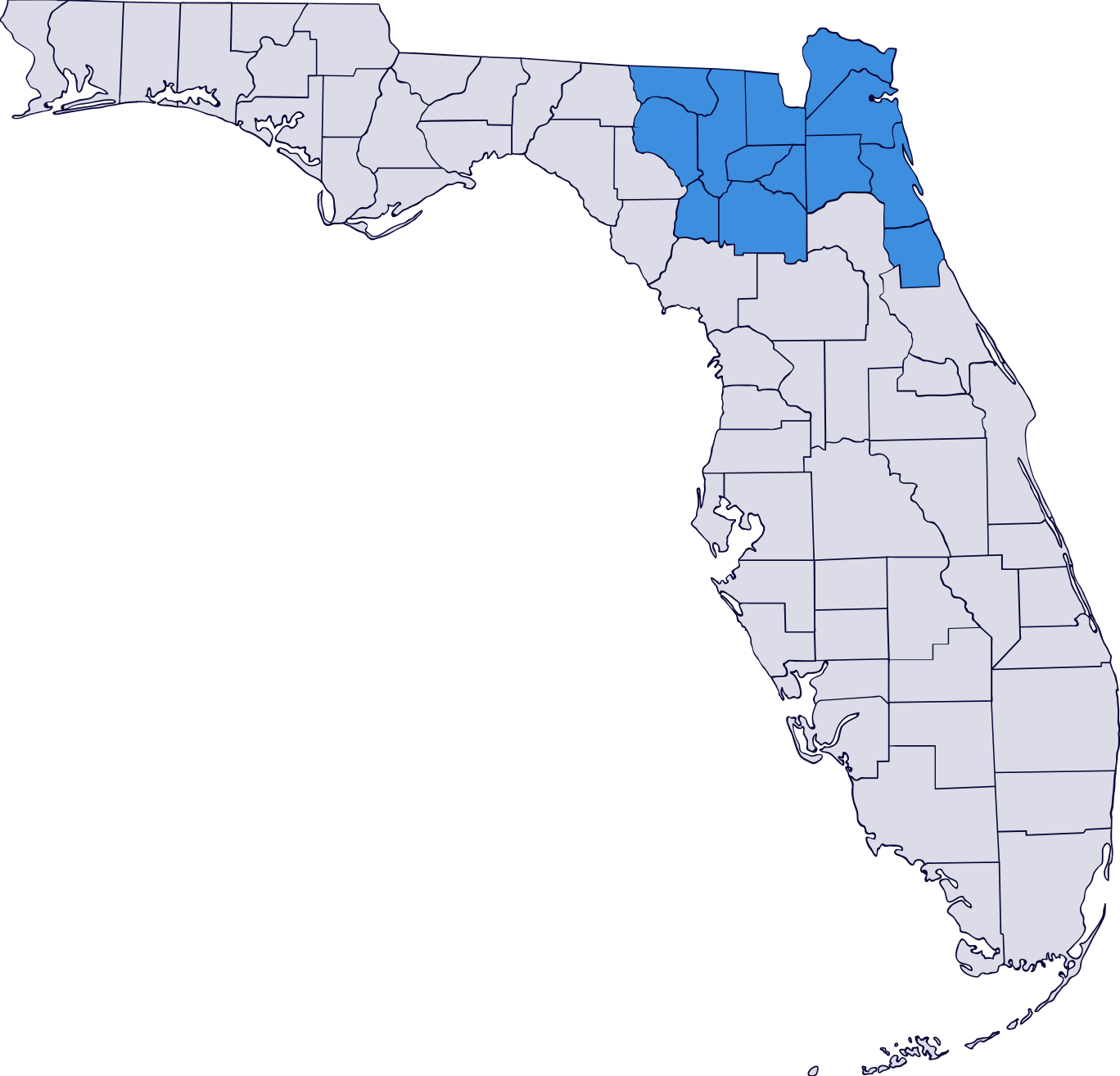

Did you know that the clock on your driving privileges starts ticking the very moment you are pulled over? Facing a first time DUI in Florida isn't just a legal hurdle; it's an immediate, high-stakes battle against a system designed to move fast. Whether you were stopped in the busy streets of Orlando, the suburbs of Tampa, or anywhere between Jacksonville and Miami, the anxiety is the same. You're likely worried about jail time, a permanent criminal record, and how you will get to work if your license is revoked.
We understand the weight of this crisis. You deserve an aggressive defense that acts as a shield for your future. This guide provides the clarity you need to navigate the complex Florida legal system with confidence. We will walk you through the critical 10-day administrative window to save your license, explain the impact of the new Trenton’s Law, and reveal proven strategies to reduce charges to reckless driving. From understanding local court expectations in South Florida to securing a hardship license in our major metropolitan hubs, we have you covered. Your future is worth protecting, and the right information is your first line of defense.
Key Takeaways
- Grasp the weight of Florida’s "Zero Tolerance" system and how law enforcement evaluates your normal faculties during a roadside stop.
- Uncover the true costs of a first time DUI in Florida, ranging from mandatory fines to the specific circumstances that lead to jail time.
- Master the 10-day administrative window to protect your license and understand the difference between your criminal court case and the DMV hearing.
- Explore assertive defense tactics that expose flaws in field sobriety tests and challenge the officer’s legal reason for pulling you over.
- Gain a localized advantage by understanding how court expectations and procedures differ across Jacksonville, Orlando, Tampa, and Miami.
The Legal Reality: What Qualifies as a First Time DUI in Florida?
Florida is widely recognized for having some of the most aggressive traffic laws in the country. If you are facing a first time DUI in Florida, you are entering a "Zero Tolerance" environment. Law enforcement officers in metros like Jacksonville and Miami are trained to prioritize arrests over warnings. But what actually qualifies as a DUI? While many people focus solely on the "legal limit," Florida law is much broader and more punitive than most realize.
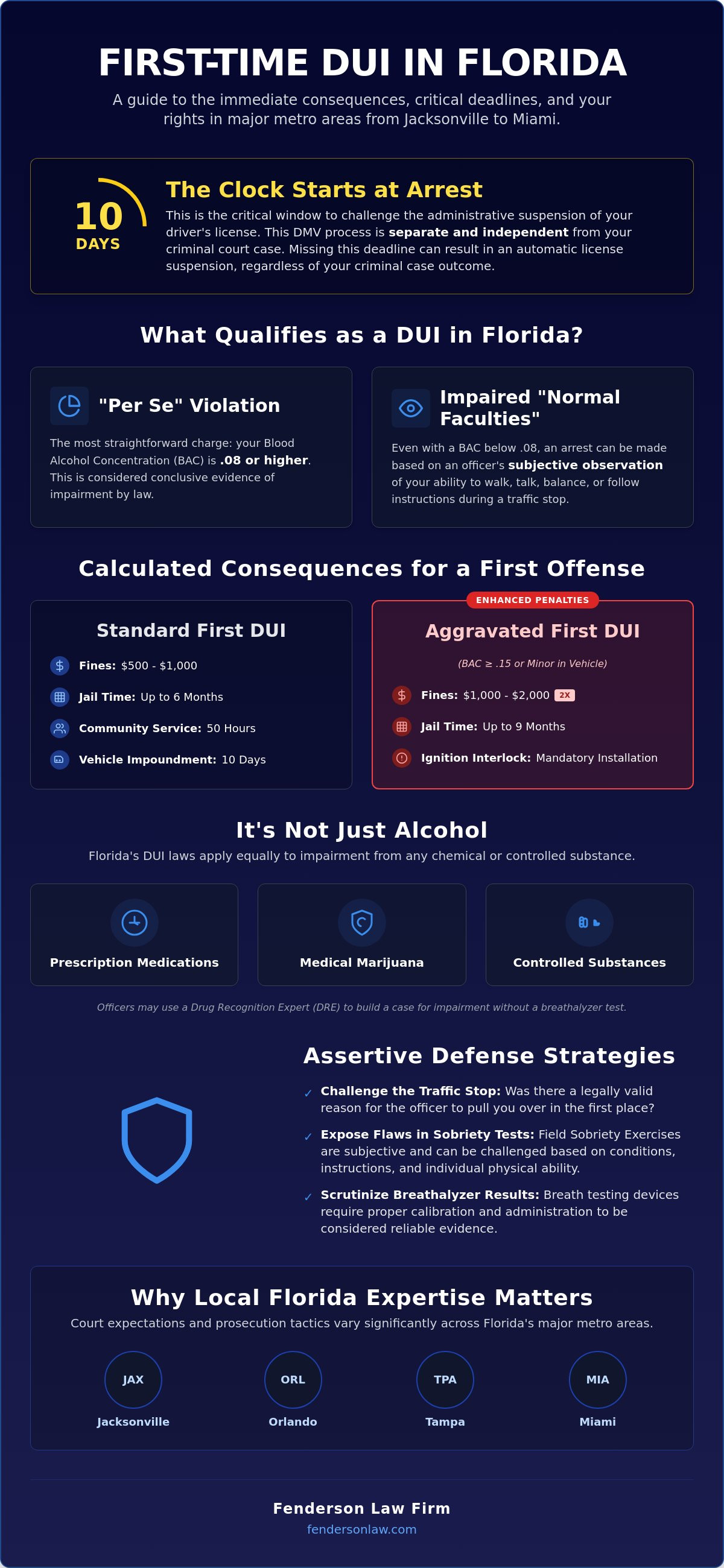
Under state statutes, a DUI is proven in two distinct ways. The first is the "per se" violation, which is having a Blood Alcohol Concentration (BAC) of .08 or higher. The second is the impairment of "normal faculties." This means even if you blow under a .08, an officer can arrest you if they believe your ability to walk, talk, or react is diminished. They judge your performance on field sobriety exercises as a window into your brain's processing speed. While Drunk driving in the United States is a national concern, Florida’s specific focus on "normal faculties" makes it exceptionally easy for an officer to initiate an arrest based on subjective observation. It's a system that often favors the accuser, which is why you need a formidable shield to protect your rights.
The stakes rise quickly if aggravating factors are present during your stop. If your BAC is .15 or higher, or if a minor was in the vehicle, you face enhanced penalties. These aren't just minor fines; they are life-altering consequences that can result in longer jail sentences and mandatory ignition interlock devices even for a first offense.
Alcohol vs. Chemical Substances
Don't let the name fool you. A DUI isn't limited to alcohol. Florida law treats prescription medications, medical marijuana, and controlled substances with the same severity. If a Tampa or Orlando officer suspects drug impairment but smells no alcohol, they often call in a Drug Recognition Expert (DRE). These specialized officers use a multi-step evaluation to claim you are under the influence of a chemical substance. Proving impairment without a breathalyzer requires an even more aggressive defense to challenge the officer's "expert" opinion and the validity of their roadside testing methods.
The Difference Between DUI and DWI in Florida
You might hear terms like DWI (Driving While Intoxicated) used in other states, but Florida officially uses "DUI" (Driving Under the Influence) as its comprehensive legal term. This distinction is vital for your record. If your arrest involved a collision, you need a personal injury lawyer near me to manage the overlap between criminal charges and civil liability. A first-time conviction can be used against you in future lawsuits, making it essential to fight the charge from day one. Whether you are in the suburbs of Miami-Dade or the heart of Duval County, understanding these definitions is the first step in building your defense shield.
Calculated Consequences: Fines, Jail Time, and Probation
A single mistake shouldn't define your life, yet the state of Florida treats a first time DUI in Florida like a high-stakes financial raid. The mandatory fine schedule is rigid. For a standard first offense, you face fines between $500 and $1,000. If your Blood Alcohol Concentration (BAC) was .15 or higher, or if a minor was in the vehicle, those costs double to a range of $1,000 to $2,000. These figures are just the beginning; they don't include the court costs and administrative fees that quickly inflate the total price of a conviction in metros like Tampa and Orlando.
What about your freedom? There is a common myth that first-time offenders never see the inside of a cell. In reality, Florida law allows for up to six months of jail time for a standard first offense. If aggravating factors are present, such as a high BAC or a minor passenger, that maximum increases to nine months. While probation is a frequent alternative, the threat of incarceration remains a powerful tool for the prosecution. You need an advocate who acts as a shield, pushing back against these aggressive tactics to keep you out of a cell.
The "hidden" costs of a conviction are often the most disruptive. You are required to complete 50 hours of community service and endure a mandatory 10-day vehicle impoundment. This impoundment cannot be served while you are in jail; it is a separate penalty designed to strip away your mobility. For a comprehensive look at these statutory requirements, you can consult the Florida DUI and Administrative Suspension Laws. These penalties are designed to be overwhelming, but they aren't inevitable if you act fast.
DUI School and Treatment Programs
Every person convicted must enroll in a Level I DUI program. This is not a simple seminar. It involves a psychosocial evaluation and mandatory attendance at classes that typically cost between $346 and $378.40. If you fail to complete this school or the recommended treatment, the state will permanently revoke your license. It is a strict, unforgiving process that requires meticulous attention to detail to avoid lifelong consequences.
Aggravating Factors That Spike Penalties
When a DUI involves property damage or personal injury, the legal landscape shifts from a misdemeanor to a full-blown crisis. If your case involved a collision in Duval County, it’s vital to talk to a car accident lawyer jacksonville fl to manage the complex overlap of criminal and civil liability. The presence of a minor in the car also triggers mandatory minimums, ensuring that the state pursues the harshest possible penalties. You can secure a shield for your defense and start fighting these charges today.
The 10-Day Window: Saving Your Florida Driver's License
Did you know your driver's license is already effectively suspended? The moment you were arrested for a first time DUI in Florida, the officer likely seized your physical plastic license. That yellow citation sitting on your dashboard isn't just a receipt for your arrest; it's your only legal authorization to drive for the next 10 calendar days. The clock started ticking the second you were processed. If you fail to act before that window closes, your right to drive will vanish on the 11th day. This isn't a threat; it's the rigid reality of Florida's administrative legal system.
You are currently fighting a two-front war. Most people focus on the criminal case, worrying about judges and jail time. However, the administrative case with the Florida Department of Highway Safety and Motor Vehicles (FLHSMV) moves much faster. These are two separate battles. Winning your criminal case months from now won't automatically fix a license suspension that you failed to challenge today. You need an aggressive shield to protect your mobility while the criminal case slowly winds through the courts. The Formal Review Hearing is your primary weapon. This is where your legal advocate challenges the officer's "probable cause" and the legality of the initial stop. If the state can't prove the officer had a valid reason to pull you over, your suspension could be set aside entirely.
Hardship Licenses and the 'Waiver' Option
For many residents in cities like Tampa and Miami, losing the ability to drive means losing their livelihood. If you have no prior DUI convictions or alcohol-related suspensions, you might be eligible for an immediate "Business Purposes Only" (BPO) license. To get this, you must waive your right to a Formal Review Hearing within that critical 10-day window. This is a strategic trade-off. By waiving the hearing, you skip the fight to overturn the suspension in exchange for the guaranteed ability to drive to work, school, and medical appointments. It’s a calculated move that keeps you on the road without the risk of a "hard suspension" period.
The Role of the Bureau of Administrative Reviews (BAR)
The Bureau of Administrative Reviews (BAR) is the specific division within the FLHSMV that possesses the sole authority to conduct license hearings and issue hardship permits. Whether you are navigating the legal landscape in Jacksonville or the suburbs of Orlando, your request for a hearing or a waiver must be filed at the local BAR office serving your county. If you miss this 10-day deadline, you face a mandatory "hard suspension" period. This means 30 to 90 days where you cannot drive for any reason whatsoever. No work. No groceries. No exceptions. Acting with urgency is the only way to prevent this total loss of freedom.
Assertive Advocacy: Defense Strategies for First-Time Offenders
The first line of defense is challenging the initial stop. Did the officer actually have a legal reason to pull you over? In busy metropolitan areas like Orlando or Jacksonville, police often cast a wide net during late-night patrols. If they lacked "Reasonable Suspicion"—a specific, articulable reason to believe a traffic violation or crime was occurring—every piece of evidence gathered after the blue lights flashed could be suppressed. Without a legal stop, the state has no case.
We also scrutinize the so-called Field Sobriety Exercises (FSEs). These are not scientific tests; they are subjective physical tasks designed for you to fail. Factors like medical conditions, inner ear issues, or even the uneven pavement on a humid Tampa roadside can make these exercises impossible for a perfectly sober person to perform. Furthermore, we dive deep into the maintenance and calibration records of the Intoxilyzer 8000. This machine is the backbone of Florida’s breath testing, but it's prone to error if not handled with meticulous care. By reviewing body cam and dash cam footage, we often find that a client's faculties were far more "normal" than the officer’s written report suggests. If the video contradicts the police narrative, it becomes a powerful weapon in your favor.
The 'Reckless Driving' Reduction
A "Wet Reckless" reduction is often the gold standard for a first-time defense. By negotiating the charge down from a DUI to reckless driving, you avoid the permanent stigma of a criminal DUI conviction on your record. This strategic move is vital for your long-term insurance premiums and your professional reputation. It transforms a life-altering crisis into a manageable traffic offense, ensuring your record remains as clean as possible.
Constitutional Violations
Your rights don't disappear just because you were pulled over on a Miami highway. If an officer failed to read your Miranda Rights at the proper time or conducted an illegal search of your vehicle, they violated your 4th Amendment protections. A single procedural error by law enforcement can lead to a total case dismissal, effectively ending the legal struggle before it reaches a courtroom. You deserve a protector who knows how to spot these errors and use them to your advantage. Don't wait to start your defense; secure your legal shield now and fight for your rights.
Why Local Florida Expertise Matters: From Jacksonville to Miami
The statutes governing a first time DUI in Florida are written in Tallahassee, but they are interpreted and enforced in local courtrooms. A case in Duval County doesn't move the same way as one in Miami-Dade. The "Shield" philosophy at Fenderson Law Firm is built on this understanding. We don't just provide generic legal advice; we provide a localized defense that recognizes the specific "players" in each jurisdiction. From the prosecutors in Tampa to the judges in Orlando, knowing the local landscape is the only way to ensure your case receives the aggressive advocacy it deserves.
Our firm treats your first offense as a battle for your future. This is especially critical when a DUI overlaps with other legal crises. If your arrest involved a tragic accident, our team provides comprehensive care by managing both the criminal defense and any related wrongful death or personal injury claims. We act as a single, formidable point of protection for our clients, ensuring that no detail is overlooked across the four major Florida metros we serve.
Jacksonville and Orlando Court Expectations
In North and Central Florida, pre-trial intervention (PTI) programs offer a lifeline for first-time offenders. However, qualifying for these programs requires a deep understanding of local rules. In Orlando, for example, the Orange County "Back on Track" program has very specific eligibility requirements and rigorous completion phases. Fenderson Law Firm’s established presence in Jacksonville and Orlando provides a distinct home-field advantage. We know how to present your case to local prosecutors to maximize your chances of entering these diversion programs, which can ultimately lead to a dismissal of your charges.
Tampa and Miami: High-Volume Jurisdictions
The 13th Judicial Circuit in Hillsborough County and the 11th Judicial Circuit in Miami-Dade are some of the busiest in the country. In these high-volume jurisdictions, cases can easily get lost in the shuffle or pushed through by a prosecution team looking for a quick conviction. You cannot afford to be just another name on a crowded docket. Aggressive advocacy is the only way to force the state to look at the flaws in their evidence. Whether you are in the suburbs of Coral Gables or the heart of downtown Tampa, you need a defender who is unafraid of conflict and deeply invested in your personal liberty. Don't face the Florida legal system alone; Contact Fenderson Law Firm for your DUI defense shield and start protecting your future today.
Take Command of Your Legal Defense Today
Your future shouldn't be derailed by a single mistake. The 10-day window to save your license is the most critical phase of your case; acting with urgency is the only way to stay on the road. Whether you are navigating the strict diversion programs in Orlando and Jacksonville or facing high-volume courts in Miami and Tampa, local expertise is your greatest asset. A first time DUI in Florida carries heavy penalties, but these consequences aren't set in stone. By challenging the legality of your stop and the accuracy of roadside exercises, we build a formidable shield around your rights.
Fenderson Law Firm brings over 15 years of legal experience to this fight. We provide aggressive advocacy across the state's major metros, offering personalized strategies that treat your case as the high-stakes battle it is. Don't let the prosecution dictate the outcome of your life. Secure Your Future with an Aggressive Florida DUI Defense Shield. You deserve a protector who will fight tirelessly for your liberty and your recovery.
Frequently Asked Questions
Is jail time mandatory for a first DUI in Florida?
Jail time is not mandatory for a standard first offense, but the judge possesses the authority to sentence you to up to six months. If your blood alcohol level was .15 or higher, that maximum incarceration period increases to nine months. While many first-time offenders receive probation, you need a formidable defense shield to ensure the prosecution does not pursue the maximum jail time allowed by law.
How long does a DUI stay on my record in Florida?
Can I get my DUI charges dropped to reckless driving?
Reducing a charge to reckless driving is a common outcome when your defense exposes critical flaws in the state's evidence. This "Wet Reckless" reduction avoids the mandatory penalties of a DUI conviction and keeps your criminal record cleaner. We meticulously review police body cam footage and breathalyzer logs to build the leverage necessary to force the prosecution into a favorable plea deal for our clients.
What is the 10-day rule for a Florida DUI?
The 10-day rule is your strict deadline to challenge the automatic administrative suspension of your driver's license. From the date of your arrest for a first time DUI in Florida, you have exactly 10 calendar days to request a formal review hearing or waive it for a hardship license. If you miss this window, you face a "hard suspension" where you cannot drive for any reason whatsoever.
Will I lose my job if I get a first-time DUI?
Florida is an "at-will" employment state, which means an employer can generally terminate you for a criminal arrest or conviction. The risk is significantly higher if your job requires a professional license or involves operating a company vehicle. By securing an immediate hardship license and fighting for a charge reduction, we aim to minimize the professional fallout and protect your livelihood from this legal crisis.
How much does a first DUI cost in Florida including legal fees?
The total cost often exceeds several thousand dollars when you factor in mandatory fines, court costs, and administrative fees. Fines alone range from $500 to $2,000 depending on your BAC levels. You must also account for DUI school, vehicle impoundment, and the inevitable spike in your insurance premiums. Investing in a powerful defense now can prevent the much higher long-term financial burden of a permanent conviction.
Do I have to install an ignition interlock device for a first offense?
Installation is mandatory for at least six months if your BAC was .15 or higher or if a minor was in the vehicle. For a standard first time DUI in Florida with a lower BAC, the judge has the discretion to order the device but isn't required to do so. We fight to keep this invasive and expensive equipment out of your vehicle to maintain your privacy and freedom.
What happens if I refused the breathalyzer test in Florida?
Refusal triggers an automatic one-year license suspension under Florida's implied consent laws. Under Trenton's Law, effective October 1, 2025, a first-time refusal is also a second-degree misdemeanor punishable by jail time and fines. This means you are now fighting both an administrative license battle and a separate criminal charge for the act of refusal itself, requiring an even more aggressive and sophisticated defense strategy.


