
Did you know that waiting just fifteen days to see a doctor in Miami or Orlando could cost you every penny of your PIP benefits? In 2026, the margin for error is zero. If you are wondering how to file a car accident claim in Florida, you aren't just filling out paperwork; you are entering a high-stakes battle against insurance giants who use the 2023 tort reforms as a weapon to slash your payout. You need more than a form; you need a shield.
It's exhausting to deal with aggressive adjusters while medical bills pile up and your future feels uncertain. We understand the fear that follows a wreck in Tampa or Jacksonville, and we know that the no-fault system often feels like it's designed to fail the victim. This guide promises to arm you with a tactical roadmap to secure maximum compensation and protect your rights under the strict two-year statute of limitations. You'll learn the exact sequence for reporting your crash, meeting the 14-day medical threshold, and bypassing the serious injury barrier to hold negligent drivers accountable from the Panhandle to the Keys.
Key Takeaways
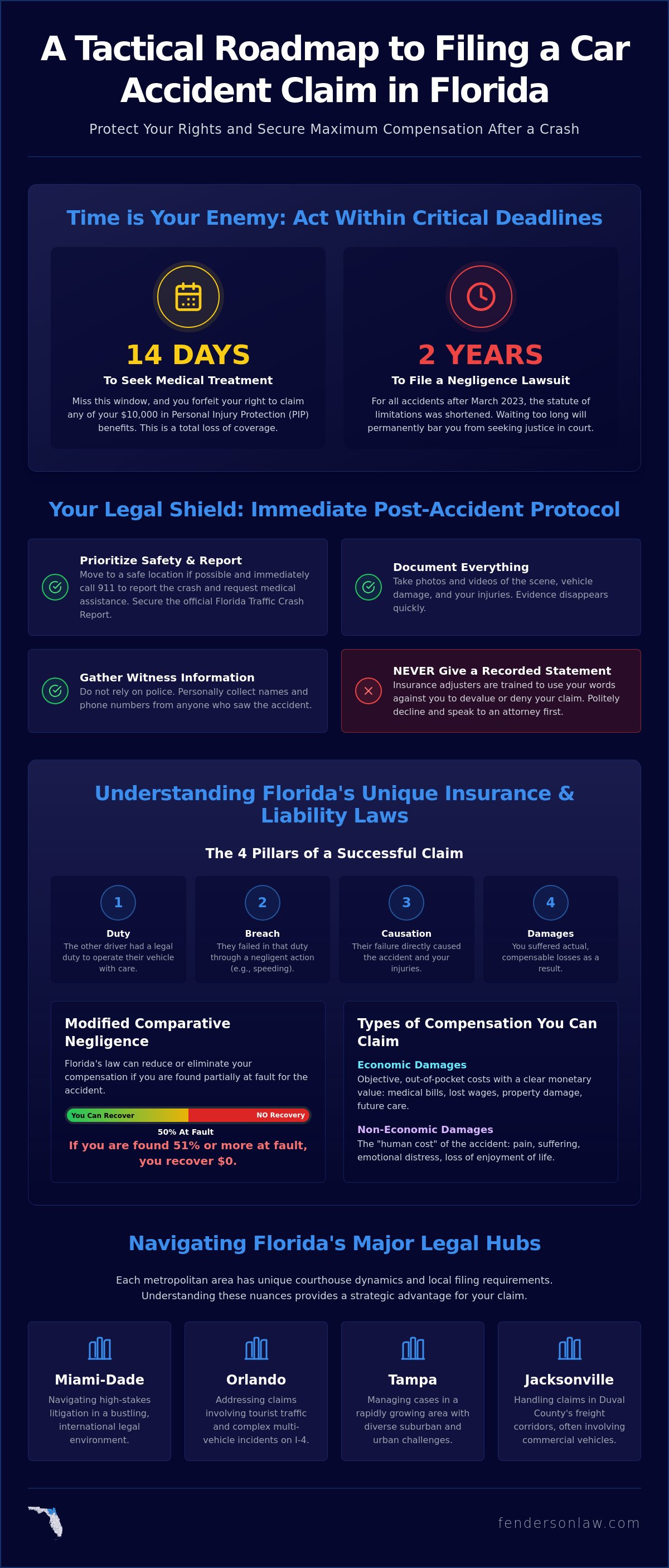
- Secure your PIP benefits by seeking medical treatment within the critical 14-day window to avoid a total loss of coverage.
- Protect your future by filing within the shortened two-year statute of limitations mandated for all Florida negligence claims occurring after March 2023.
- Learn the tactical steps on how to file a car accident claim in Florida to overcome the 51 percent modified comparative negligence bar.
- Deploy a comprehensive demand package that transforms your medical records and scene evidence into a legal shield against aggressive insurance adjusters.
- Gain a strategic advantage by understanding the unique courthouse dynamics and local filing requirements in major hubs like Miami, Tampa, Orlando, and Jacksonville.
Understanding Your Right to a Personal Injury Claim in Florida
A personal injury claim is not just a request for financial help; it is a calculated legal demand for justice against those who have upended your life through negligence. Whether you are recovering from a wreck on the busy streets of Miami or a quiet intersection in Coral Gables, the law provides a path to restoration. Knowing how to file a car accident claim in Florida starts with recognizing that your injuries have a price, and the party responsible must pay it. You are not a victim waiting for a handout. You are a claimant demanding what is legally yours.
This pursuit of justice is grounded in understanding tort law, which serves as the foundation for holding individuals and corporations accountable for the harm they cause. In Florida, your claim must stand on four unshakable pillars to succeed in court. First, you must prove Duty, showing the other driver had a legal obligation to act with care. Second, you must prove Breach, showing they failed that duty through action or inaction, such as speeding through Brandon. Third, you must establish Causation, proving their failure directly caused your crash. Finally, you must demonstrate Damages, showing you suffered actual, compensable losses.
We fight for two distinct categories of compensation to ensure your recovery is total. Economic damages cover the objective, out-of-pocket costs like emergency surgery in Jacksonville or lost wages from a missed shift in Orange Park. Non-economic damages address the human cost: the pain, suffering, and loss of life's pleasures that no receipt can fully capture. Whether it involves a standard passenger car, a massive commercial truck, or a motorcycle crash on the coast, we act as your shield against the entities trying to minimize these losses, often collaborating with South Florida business law experts like Matthew Fornaro, P.A. when commercial liability is at stake.
The Concept of Negligence in Florida Law
Negligence is the failure to act with the care that a person of ordinary prudence would exercise. In 2026, Florida courts measure "reasonable care" by looking at the specific circumstances of the crash. A commercial truck driver navigating the freight corridors of Duval County is held to a different standard of vigilance than a commuter in Winter Park. We command the technical knowledge to prove when these standards are ignored, ensuring that "accidents" are recognized as the preventable failures they truly are. Proving negligence is the first step in how to file a car accident claim in Florida that actually wins.
Types of Injuries That Warrant a Claim
Your road to recovery may involve catastrophic injuries like traumatic brain injuries (TBI) or permanent spinal damage that require a lifetime of specialized care. However, we also stand for those suffering from "invisible" injuries that others might overlook. Insurance giants often devalue whiplash or PTSD, but these conditions can be just as debilitating for a family in Orlando. In the most tragic cases, we represent grieving families through wrongful death claims. We seek the moral and financial authority needed to protect your family's future after an unthinkable loss.
Immediate Tactical Steps: The Foundation of Your Florida Claim
The moments following a collision on I-95 in Miami or I-4 in Orlando are chaotic. But they're also the most critical for your legal future. Success depends on your ability to follow the official steps to take after a car accident. If you want to know how to file a car accident claim in Florida that doesn't get rejected, you must act as your own first responder. You are building a legal shield from the ground up before the Florida Highway Patrol even clears the scene in Jacksonville or Tampa.
Evidence disappears fast. While law enforcement focuses on restoring traffic in Miami-Dade or Duval County, you must focus on preservation. Secure the official Florida Traffic Crash Report immediately. Don't rely on the police to gather every witness's contact information. Record names and phone numbers yourself. If you wait, those witnesses might vanish into the suburbs of Brandon or Coral Gables, taking their testimony with them. Most importantly, refuse to provide recorded statements to insurance adjusters. They are trained to weaponize your words against you. If you feel pressured, it's time to let a seasoned protector take the lead.
The Critical 14-Day Medical Rule
Florida law is unforgiving. You have exactly 14 days to seek medical treatment. If you miss this window, your $10,000 in Personal Injury Protection (PIP) benefits could vanish. To unlock the full benefit, a medical professional must diagnose an Emergency Medical Condition (EMC). This means your injury is severe enough that a lack of immediate care could result in serious jeopardy to your health. When speaking to doctors in Tampa or Winter Park, be exhaustive. List every ache, mention the whiplash, and document the PTSD. These records are the primary evidence in how to file a car accident claim in Florida successfully.
Evidence Gathering for Maximum Leverage
Photographs are your most powerful weapon. Capture vehicle damage from multiple angles to prove the force of impact. In truck accident claims, we fight to preserve "Black Box" data, which reveals speed and braking patterns that often contradict a driver's story. Keep everything. Torn clothing, defective vehicle parts, and even dashcam footage from a wreck in Orange Park can turn the tide of a case. We use this physical evidence to force insurance giants into a position where they must offer a fair settlement or face us in court.
Navigating Florida’s Unique Insurance and Liability Laws
Florida's insurance laws are designed to favor the powerful, not the injured. If you are learning how to file a car accident claim in Florida, you must understand that the "No-Fault" label is often a deceptive shield for insurance companies. It doesn't mean no one is responsible; it means the system forces you to exhaust your own $10,000 PIP limit before you can even look at the at-fault driver's policy. This is where Florida PIP Insurance: Does No-Fault Cover Your Injuries? becomes a critical component of your strategy. While PIP covers 80 percent of medical bills, a Bodily Injury (BI) claim is your only path to securing full reimbursement and non-economic damages for pain and suffering.
The 2023 tort reforms shifted the battlefield in favor of corporate giants. In 2026, insurance adjusters in Miami and Jacksonville are more aggressive than ever. They use the new "Modified Comparative Negligence" rule as a sword to cut your compensation. If they can convince a jury in Tampa or Orlando that you were 51 percent responsible for the crash, you recover nothing. Zero. This "51 percent bar" is a trap designed to disqualify victims entirely. We act as your shield, gathering the forensic evidence needed to keep the blame where it belongs: on the negligent party who caused the wreck in Brandon or Coral Gables.
Given that Florida has one of the highest rates of uninsured drivers in the nation, Uninsured/Underinsured Motorist (UM) coverage is your last line of defense. If a driver hits you in Winter Park and has no insurance, your UM policy steps in to act as the at-fault party's coverage. Without it, you could be left holding the bill for a lifetime of medical care. Understanding how to file a car accident claim in Florida means knowing which policies to trigger and when to strike.
The 2-Year Statute of Limitations Warning
Time is your greatest enemy. For any car accident occurring on or after March 24, 2023, the window to file a negligence claim has been slashed from four years to just two. This means you have half the time to investigate, treat, and litigate. While rare exceptions exist for minors or specific medical malpractice scenarios, the rule is rigid for most. Missing this deadline is an absolute bar to recovery in Florida. If that clock runs out, your right to justice dies with it, regardless of how severe your injuries are.
Comparative Fault: Can You Still Recover if Partially Blamed?
You can still recover if you are partially at fault, provided your responsibility is 50 percent or less. Your final settlement is simply reduced by your percentage of blame. If a court in Duval County finds you 20 percent at fault for a wreck, you receive 80 percent of the total damages. However, insurance giants will fight tooth and nail to push you over that 51 percent threshold. They want to disqualify you entirely. You need a legal warrior who can anticipate these tactics and shut them down before they cost you your recovery.
The Step-by-Step Process of Filing and Negotiating Your Claim
Mastering the tactical stages of how to file a car accident claim in Florida requires more than just filling out forms; it requires a battle plan. The path from a mangled vehicle in Tampa to a successful settlement check is a strategic march that demands precision. You are not just asking for money. You are building a case that is so formidable the insurance company has no choice but to pay. This process must be handled with the urgency that the 2026 legal environment demands, especially given the strict two-year statute of limitations.
- Step 1: The Investigation. This is the bedrock of how to file a car accident claim in Florida that survives the scrutiny of a courtroom. We gather every medical record from hospitals in Miami and repair bills from shops in Brandon. We don't just collect data; we command it, securing expert testimony from accident reconstructionists to prove exactly how the crash occurred on the streets of Jacksonville.
- Step 2: The Demand Package. This is your legal shield. It's a comprehensive presentation of evidence that leaves the insurer no room to hide. We present the full scope of your damages, from immediate medical costs in Orlando to the long-term psychological impact on your family in Orange Park.
- Step 3: Negotiation. Expect an aggressive back-and-forth. Adjusters in Florida are paid to save their company money, not to help you. We strike back with facts and legal authority to push for a settlement that reflects your true losses.
- Step 4: Filing the Lawsuit. If the insurer acts in bad faith, we escalate. Filing a lawsuit in a Florida circuit court signals that you're prepared for war. This stage involves paying specific filing fees and serving the defendant with the legal complaint.
- Step 5: Discovery and Mediation. This is the final stage of pressure. Mediation offers a chance to settle before a jury in Duval or Miami-Dade County hears the case, often resulting in a resolution that avoids the uncertainty of a trial.
If you're facing delays or lowball offers from an insurer, you don't have to fight alone. Contact our determined protectors today for a tactical evaluation of your case.
Crafting a Powerful Demand Letter
A demand letter is your first strike. We calculate the full value of your claim by projecting future medical care needed in cities like Winter Park or Coral Gables. We don't accept the first offer because it's almost always a lowball attempt to make you go away. By including Bad Faith warnings, we force insurance giants to play fair or face severe legal consequences for their stalling tactics.
When to Move from Claim to Lawsuit
You must know when to stop talking and start litigating. If an insurer uses unnecessary delays or flat denials, they're acting in bad faith. Filing a lawsuit shows them you aren't afraid of a fight. In many Florida cases, mediation serves as a powerful tool during litigation, allowing both sides to reach a fair agreement without the time and expense of a full jury trial. We ensure you stay on the offensive until justice is served.
Why Local Representation in Jacksonville, Orlando, Tampa, and Miami Matters
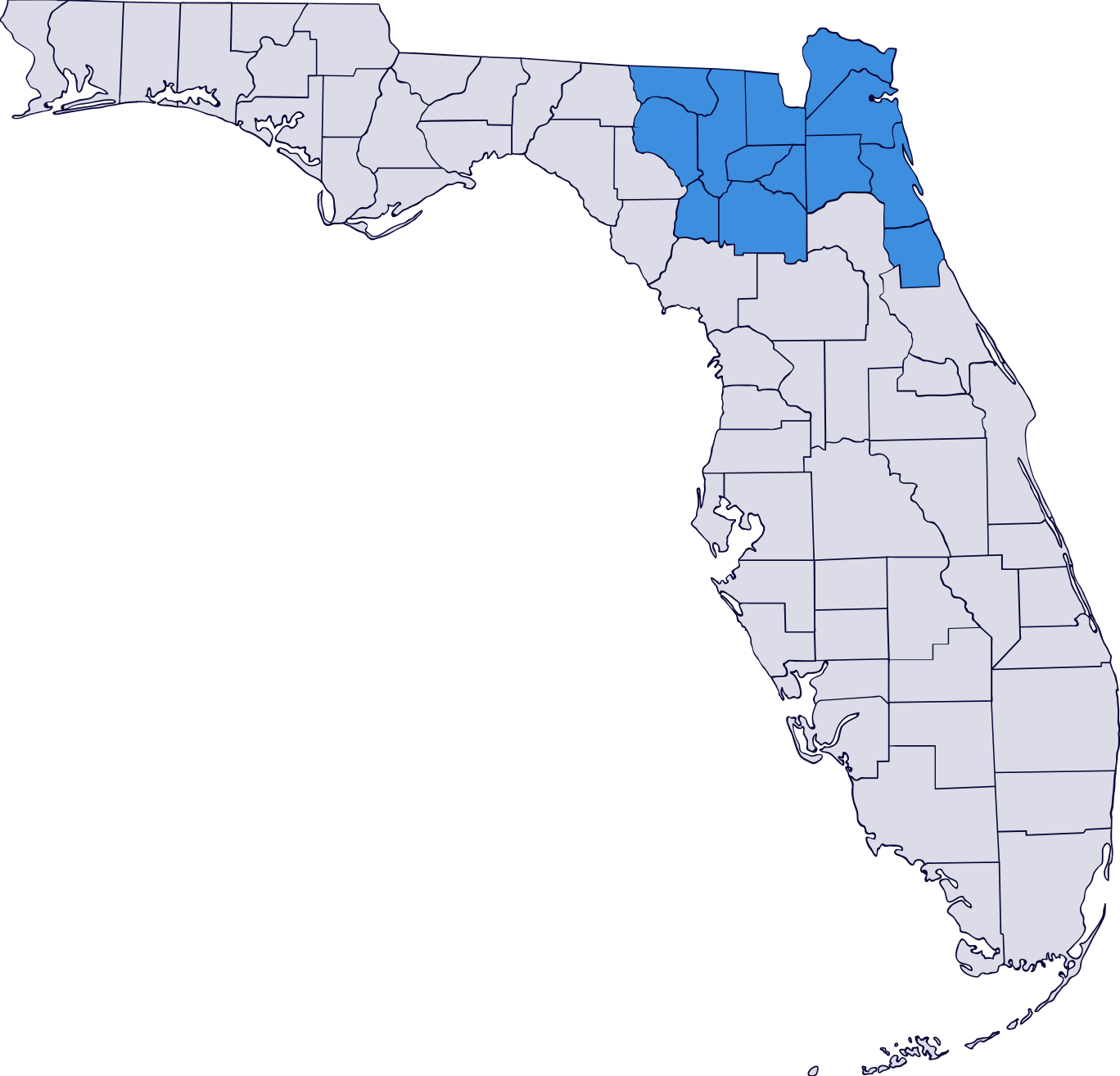
Local representation is the difference between a generic filing and a winning strategy. When you're deciding how to file a car accident claim in Florida, you must account for the distinct legal climates of our state's diverse regions. A claim filed in the conservative courtrooms of Jacksonville's Duval County moves with a different rhythm than one handled in the fast-paced, high-volume environment of Miami-Dade. We don't just know the law; we know the people who interpret it. From the suburbs of Orange Park and Winter Park to the bustling streets of Brandon and Coral Gables, our presence ensures that no detail of your local situation is overlooked.
Knowing the local medical landscape is equally vital for your recovery. We understand which providers in Tampa or Orlando offer the most comprehensive documentation to satisfy the 14-day PIP window. This local intelligence strengthens your claim's credibility. It makes it nearly impossible for insurance giants to dismiss your injuries as minor or unrelated to the crash. Our Determined Protector approach isn't limited to a single office. We are a constant, formidable force across the I-4 corridor, acting as a shield for families who have been blindsided by a legal crisis.
Regional Nuances in Florida Personal Injury Claims
The composition of a jury pool can change the entire trajectory of your case. A jury in North Florida may view non-economic damages through a different lens than one in South Florida. We maintain a tactical advantage by knowing the local insurance defense firms that operate in these specific jurisdictions. We anticipate their moves because we've faced them in these exact courtrooms before. If you need a car accident lawyer jacksonville fl, you need someone who understands the local bench and the specific expectations of Duval County judges.
Fenderson Law Firm: Your Shield Across the Sunshine State
Our commitment to your justice is backed by a performance-based promise. We operate on a no-recovery, no-fee basis. This ensures that financial barriers never stand in the way of elite representation. It is the cornerstone of our accessibility. We are seasoned warriors who provide aggressive advocacy for your future while offering the compassionate support you need to heal. Finding a personal injury lawyer near me means choosing an ally who is both formidable in court and deeply invested in your personal recovery. We are tireless, omnipresent, and ready to strike.
Take Command of Your Legal Recovery
The window to act is closing faster than ever. By now, you understand that mastering how to file a car accident claim in Florida is about more than just paperwork; it's about strategic timing and aggressive evidence preservation. You must secure medical treatment within fourteen days to protect your PIP benefits and file your negligence claim before the strict two-year deadline expires. Whether you are fighting an adjuster in Tampa or preparing for mediation in Miami, you don't have to carry this burden alone. The legal landscape has changed, but your right to justice remains our priority.
Fenderson Law Firm has provided over 15 years of aggressive advocacy for victims across Jacksonville, Orlando, Tampa, and Miami. We act as a shield for your future, ensuring that insurance giants don't use the 51 percent fault bar to silence your voice. Our No Recovery, No Fee Guarantee means our interests are perfectly aligned with yours. We don't win unless you win. Don't let fear or uncertainty dictate your recovery. Take the first step toward the justice you deserve today.
Secure Your Future: Schedule Your Free Florida Injury Consultation Now
Frequently Asked Questions
How long do I have to file a car accident claim in Florida in 2026?
You have exactly two years from the date of your accident to file a negligence claim for any crash occurring on or after March 24, 2023. This shortened window is a result of recent tort reforms and applies strictly across the state. If you fail to initiate legal action within this timeframe in cities like Jacksonville or Miami, you will lose your right to seek compensation forever.
Can I file a claim if I was partially at fault for the accident?
Yes, you can still recover damages as long as your percentage of fault is 50 percent or less. Florida uses a modified comparative negligence rule, which means your final payout is reduced by your share of the blame. However, if a court in Tampa or Orlando determines you were 51 percent or more responsible, you are legally barred from recovering any compensation from other parties.
What is the 14-day rule for Florida car accidents?
The 14-day rule requires you to seek professional medical evaluation within 14 days of your collision to qualify for Personal Injury Protection (PIP) benefits. Missing this critical window in suburbs like Brandon or Winter Park results in a complete forfeiture of your $10,000 in medical and wage coverage. This requirement is a foundational element of how to file a car accident claim in Florida successfully.
How much does it cost to hire a personal injury lawyer in Florida?
Hiring an aggressive advocate for your claim typically costs nothing upfront because most firms operate on a contingency fee basis. You aren't required to pay hourly rates or retainers; instead, the firm only receives payment if they successfully recover a settlement or jury verdict for you. This performance-based guarantee ensures that victims in Coral Gables or Orange Park have access to a seasoned warrior regardless of their bank balance. To assist in this search, EMS Accident Cases connects motor vehicle accident victims with experienced attorneys to facilitate their legal recovery process.
What kind of compensation can I get in a Florida injury claim?
You are entitled to seek both economic and non-economic damages to cover the full spectrum of your losses. This includes reimbursement for emergency room visits, ongoing physical therapy, and lost income from missed work days. If your injuries meet the state's serious injury threshold, we also pursue compensation for your pain, suffering, and the long-term impact the crash has had on your quality of life.
Do I have to go to court to get a settlement in Florida?
Most car accident cases are resolved through aggressive negotiation or mediation before a trial ever begins. While many claims in Duval or Miami-Dade County settle out of court, we prepare every case as if it is heading to a jury. This mindset provides the necessary leverage to force insurance companies into a fair settlement, as they often prefer avoiding the high costs and risks of a public courtroom battle.
What happens if the person who hit me doesn’t have insurance?
If you are hit by an uninsured driver, your primary path to recovery is through your own Uninsured Motorist (UM) coverage. This policy acts as a shield, providing the funds that the at-fault driver’s insurance should have covered. Navigating how to file a car accident claim in Florida when the other party is uninsured is a complex tactical process that requires identifying every available policy to protect your financial future.
How do I know if my personal injury case is strong enough to win?
A strong case is built on clear evidence of another party's negligence and documented proof of your physical and financial damages. We look for a definitive breach of duty, such as a driver speeding through an Orlando intersection or a distracted trucker on I-95. If we can establish that their failure directly caused your injuries and resulted in real losses, your claim has the moral and legal authority needed to win.


