Did you know that saying "no" to a roadside test in South Florida can now trigger an immediate criminal charge before you even leave the scene? Under the strict laws effective in 2026, the stakes have never been higher for local drivers. You're likely wondering exactly what happens if you refuse a breathalyzer in Miami and whether your career is about to be derailed by a permanent record. It's natural to feel overwhelmed by the complexity of implied consent and the aggressive tactics used by law enforcement. We understand the anxiety of facing a system that feels designed to make you fail, especially when your ability to navigate Miami traffic is on the line.
You don't have to face this legal storm alone. This guide promises to reveal the immediate consequences of your refusal and, more importantly, how to shield your license before the critical 10-day DHSMV clock expires. We will preview the specific 2026 criminal penalties, explain the process for securing a hardship permit, and outline the strategies used to challenge a DUI conviction. Your future shouldn't be defined by a single moment of uncertainty. Let's explore how to safeguard your rights and keep you on the road.
Key Takeaways
- Understand Florida's implied consent law and why your driver's license is a privilege the state can revoke immediately if you say no.
- Learn exactly what happens if you refuse a breathalyzer in Miami under 2026 laws, including automatic 12 month suspensions and potential jail time.
- Evaluate the strategic trade-offs between refusing a test to limit scientific evidence and the legal hurdles created by the state's "consciousness of guilt" argument.
- Use the critical 10 day window to request a Formal Review Hearing and secure a temporary permit before your driving privileges are gone.
- Discover how aggressive legal defense can dismantle the prosecution's case by challenging the probable cause of your arrest on Miami roads like I-95 or US-1.
Understanding Florida’s Implied Consent Law in Miami-Dade
When you're navigating the heavy traffic on I-95 or cruising through the streets of Coral Gables, you aren't just driving; you're fulfilling a legal contract. Most drivers don't realize that their signature at the DMV was more than just a bureaucratic hurdle. It was a binding agreement. Understanding Florida’s Implied Consent Law is vital because it dictates exactly what happens if you refuse a breathalyzer in Miami. The moment you accepted your Florida driver’s license, or even just drove on a Miami-Dade road as an out-of-state visitor, you legally agreed to submit to chemical testing if an officer suspects you're impaired.
This "implied" nature means you don't need to sign a fresh waiver during a high-stress traffic stop. The law assumes your consent is already on file. Miami-Dade police officers are specifically trained to look for any hesitation. If you say no, they don't just stop. They immediately begin documenting your refusal on standardized forms that the DHSMV uses to strip away your driving privileges. Officers in jurisdictions like Miami Beach or Doral are taught that a refusal isn't just a lack of evidence; it's a strategic opening for the prosecution. They'll note your speech, your stance, and the exact words you used to decline the test to build a case against you.
The Legal Agreement You Made at the DMV
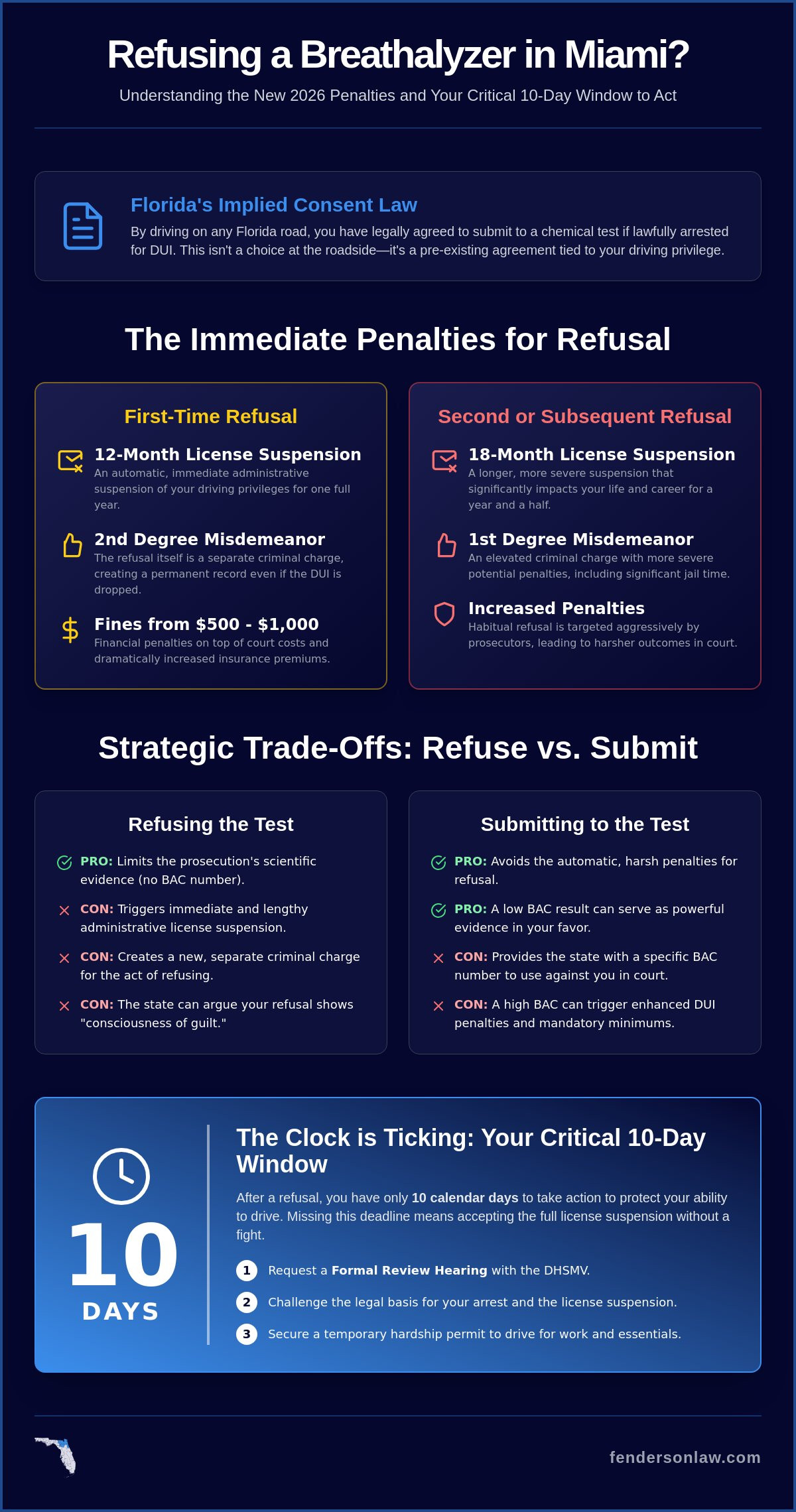
Under Florida law, driving is strictly a privilege granted by the state, not an inherent right. This distinction allows Miami law enforcement to seize your physical license immediately if you decline a test. Florida Statute 316.1932 states that any person who accepts the privilege of driving in Florida has, by so doing, given their implied consent to submit to a chemical test of their breath, blood, or urine if they are lawfully arrested for driving under the influence. This isn't just a suggestion. It's the foundation the state uses to justify harsh administrative penalties before you ever step foot in a courtroom. Whether you live in Kendall or are just visiting Wynwood, the rules remain the same.
Breath, Blood, or Urine: What Can They Demand?
In most Miami DUI stops, the officer will demand a breath sample using the Intoxilyzer 8000 located at the station. Don't confuse this with the small, portable breath test (PBT) often used at the roadside in Hialeah or Homestead. While the PBT helps an officer establish probable cause for an arrest, the station-based test is the one that carries the weight of the implied consent law. If there is a crash involving serious bodily injury or death, the law permits a mandatory blood draw, even if you refuse. An officer must have "reasonable grounds" to believe you were driving under the influence before making these demands. If those grounds are weak, we have a starting point to fight for your future and challenge what happens if you refuse a breathalyzer in Miami.
The Immediate Penalties for Refusal in 2026
The legal landscape in South Florida shifted dramatically on October 1, 2025. If you're pulled over in Miami today, the old advice of "just don't blow" could lead you straight into a jail cell. Understanding what happens if you refuse a breathalyzer in Miami starts with realizing that refusal is now a criminal offense in its own right. The state no longer views this as a simple administrative choice. It's a direct challenge to the law, and Miami prosecutors are increasingly aggressive in targeting what they call "habitual refusal."
Under the updated Florida Statute 316.1932, the consequences are split into two punishing tracks: administrative and criminal. Even if a judge eventually throws out your DUI charge, the Department of Highway Safety and Motor Vehicles (DHSMV) moves forward with its own penalties. These include:
- First Refusal: An automatic 12-month administrative license suspension and a second-degree misdemeanor charge.
- Second or Subsequent Refusal: An 18-month suspension and a first-degree misdemeanor charge.
- Financial Impact: Fines ranging from $500 to $1,000, excluding court costs and soaring insurance premiums.
- Criminal Record: A permanent mark that can derail background checks for jobs in Miami’s competitive sectors.
First-Time Refusal: The Year Without a License
Your license is seized the moment you refuse the test. For a first-timer, this means a full year without the legal right to drive. In a city where commuting from Kendall to Downtown or Homestead to Miami Beach is a daily necessity, this is devastating. The DHSMV operates independently of the criminal courts. They don't care if the officer lacked a strong reason for the stop; they only care that you violated the implied consent agreement. You cannot simply wait out this year. Without immediate legal intervention, you lose your mobility and your independence in the blink of an eye.
Second Refusal: When a Civil Matter Becomes a Crime
If you have a prior refusal on your record, the state stops treating you with leniency. A second refusal is a first-degree misdemeanor. This means you face up to one year in a Miami-Dade county jail. Prosecutors use these 2026 laws to paint you as someone who intentionally hides evidence. It's a high-stakes battle where the state tries to take your liberty along with your license. We act as a shield in these moments, fighting to protect you from the harshest criminal sanctions. If you're facing these life-altering charges, securing experienced DUI defense representation is the only way to level the playing field against the state's power.
Refusal vs. Submission: The Strategic Comparison
Deciding whether to blow into a machine at 2 AM on the side of a Miami road is a high-stakes gamble. You're essentially choosing between two different types of legal battles. If you refuse, you deny the state the scientific evidence they crave, but you trigger immediate administrative license suspension penalties. This choice is at the heart of what happens if you refuse a breathalyzer in Miami. While you might avoid a high blow reading that complicates your defense, you're handing the prosecutor a different weapon: your silence.
Miami-Dade judges often see refusal cases as a double-edged sword. Without a BAC reading, the prosecution must rely heavily on officer testimony and body camera footage. If the video shows you speaking clearly and standing steady, the lack of a breath test can be a massive advantage for the defense. However, if the footage depicts stumbling or slurred speech, the jury might view your refusal as the final piece of proof that you were hiding your true level of impairment. Consider these factors:
- Refusal Pros: No permanent record of your exact alcohol level; harder for the state to prove "impairment per se."
- Refusal Cons: Automatic license seizure; prosecutors can argue you were "hiding" your guilt.
- Submission Pros: You might blow under 0.08, leading to an immediate release and no suspension.
- Submission Cons: If you blow over 0.08, the state has a mathematical "smoking gun" to use against you.
The 'Consciousness of Guilt' Trap in Miami Courts
In Miami-Dade courtrooms, prosecutors love to use a specific jury instruction called "consciousness of guilt." They tell the jury that the only reason a person would refuse a breathalyzer is because they knew they would fail. It’s a psychological trap designed to make you look guilty for exercising a choice. We fight this narrative by presenting alternative reasons for your refusal. Perhaps you have a medical condition that makes deep breathing difficult, or maybe you simply don't trust the maintenance records of the specific Intoxilyzer used in the Miami-Dade station. For a deeper look at how we dismantle these arguments, see our guide on Florida DUI Lawyer: Defense for Your Future.
Why a 'High Blow' Can Be Just as Dangerous
Submitting to the test isn't always the safer path. If you provide a sample of 0.15 BAC or higher, you face enhanced penalties under the 2026 statutes. This includes mandatory ignition interlock devices and significantly higher fines. In Miami, a high blow makes it much harder to negotiate a "wet reckless" or other reduced charges. You're trading the certainty of a refusal suspension for the probability of a much more severe DUI conviction. We help you weigh these risks in real-time, acting as your shield against a system that wants to see you fail. Whether you're in Miami Gardens or Coral Gables, the strategy must be tailored to your specific stop.
The 10-Day Clock: Saving Your Miami Driving Privileges
The moment you walk out of the police station in Miami, a countdown begins. Your physical driver's license is gone, replaced by a paper citation that serves as your only legal right to drive for the next ten days. Many people ask what happens if you refuse a breathalyzer in Miami, assuming the suspension is set in stone. It isn't. You must act with precision to avoid a total loss of mobility. If you miss the 10-day deadline to request a Formal Review Hearing with the Florida Department of Highway Safety and Motor Vehicles (DHSMV), your license will be suspended for a full year. For the first 90 days of that year, you won't even be eligible for a hardship permit. This "hard suspension" can be a death sentence for your career and your daily life in South Florida.
Saving your license is a multi-step operation that requires immediate action. First, treat your citation as the temporary permit it is. Second, you must file a formal request for a hearing. Third, you need to prepare the legal defense that will be presented to the administrative hearing officer. Finally, you must apply for a "Business Purpose Only" license if the suspension is not immediately overturned. Each step requires a deep understanding of Miami-Dade legal procedures and the specific 2026 DHSMV regulations. We navigate this system every day to keep our clients on the road.
The DHSMV Formal Review Hearing Process
The DHSMV Formal Review Hearing is a civil battleground. Unlike your criminal case in the Miami-Dade County Court, the rules of evidence here are relaxed. This hearing is our opportunity to cross-examine the arresting officer from the Miami Police Department or the Florida Highway Patrol. We scrutinize their reports to see if they followed proper procedure during the stop on the Palmetto Expressway or near the Port of Miami. The hearing officer decides if the officer had probable cause and if you were legally informed of the consequences of refusal. This 10-day deadline is absolute and non-negotiable; once it passes, your window for a challenge slams shut.
Hardship Licenses: Can You Still Drive in Miami?
If you need to keep your job in Kendall or get your kids to school in North Miami, a "Business Purpose Only" (BPO) license is your lifeline. In 2026, eligibility for this hardship permit depends on your prior record and your willingness to navigate the DHSMV's requirements. A BPO license allows you to drive for work, school, religious services, and medical appointments. Be cautious, though. Some may suggest waiving your right to a hearing to get an immediate hardship license. This is often a trap. By waiving the hearing, you lose the chance to see the state's evidence early and potentially win your full driving privileges back. We act as your shield to ensure you don't trade away your long-term rights for a short-term fix. Protect your livelihood by securing aggressive DUI defense before your 10-day clock runs out.
How Fenderson Law Firm Shields Your Future After a Refusal
Facing the power of the state can feel like a losing battle. When the police report paints a one-sided picture of your arrest, you need a Determined Protector to rewrite the narrative. We don't just accept the officer's version of events. We scrutinize every detail of what happens if you refuse a breathalyzer in Miami to find the cracks in the prosecution's case. Our mission is to act as your shield, ensuring that a single night doesn't destroy your future or your ability to provide for your family. Whether you are in Miami, Jacksonville, Orlando, Tampa, St. Petersburg, Hialeah, Tallahassee, Port St. Lucie, Cape Coral, or Fort Lauderdale, our commitment to your liberty remains unwavering.
Our defense begins at the very start of the encounter. Was there truly a "reasonable suspicion" for the initial traffic stop on I-95 or US-1? If the officer lacked a valid legal reason to pull you over, any evidence gathered afterward, including your refusal, may be suppressed. We move from the stop to the arrest itself, attacking the "probable cause" used to take you into custody. Did the officer actually witness signs of impairment, or were they just following a script? If the officer's observations were flawed or their refusal warnings were procedurally incorrect under Miami-Dade Police Department standards, the entire foundation of the state's case begins to crumble. We provide this exhaustive level of support for clients in Pembroke Pines, Hollywood, Miramar, Coral Springs, Gainesville, Lehigh Acres, Clearwater, Miami Gardens, Brandon, and Palm Bay.
Aggressive Advocacy Against Miami Prosecutors
Miami prosecutors rely heavily on the "consciousness of guilt" argument. They want the jury to believe your refusal was a confession. We dismantle this by highlighting the many legitimate reasons a person might decline a breath test, from a lack of trust in the equipment's maintenance to simple physical discomfort. Our local Miami-Dade legal knowledge allows us to negotiate from a position of strength, often leading to reduced charges or dismissals. While our focus is here in South Florida, our reach extends across the state to protect every citizen. You can learn more about our broad expertise by reading about Jacksonville DUI Lawyer Defense Strategies.
Take Action Before the Clock Runs Out
The 10-day window is closing fast. For residents in Hialeah, Coral Gables, and throughout Miami-Dade, there is no time for hesitation. You deserve the peace of mind that comes with a professional legal shield standing between you and a life-altering conviction. We are ready to fight for your license and your liberty. Don't let the state dictate your future. Contact Fenderson Law Firm for a Free Miami DUI Consultation today and discover what happens if you refuse a breathalyzer in Miami when you have a seasoned warrior on your side. We are tireless, we are accessible, and we are ready to defend your rights in every corner of Florida.
Defend Your Rights and Reclaim Your Mobility
Navigating the aftermath of a DUI stop in South Florida requires more than just hope; it demands a calculated strategy. You now understand that the 2026 legal landscape has criminalized refusal, making it essential to act before the state cements its case against you. The 10-day clock for your administrative hearing is ticking. Missing this window means losing your license for a year without the possibility of a hardship permit for months. Knowing what happens if you refuse a breathalyzer in Miami is only half the battle. The other half is securing a legal shield that refuses to back down.
Fenderson Law provides aggressive DUI defense and proven 10-day license protection strategies for drivers from Homestead to North Miami Beach. As a determined protector of Florida rights, we fight to dismantle the "consciousness of guilt" narrative and protect your livelihood. Don't let a single moment of uncertainty define your entire future. We are here to stand between you and the state's aggressive prosecutors. Shield your future. Get a free Miami DUI consultation now. You have the right to a formidable defense, and we are ready to deliver it.
Frequently Asked Questions
Is refusing a breathalyzer a crime in Miami?
Yes, refusing a breathalyzer is now a criminal offense in Florida. Under the laws effective in 2026, a first-time refusal is a second-degree misdemeanor. This means you face up to 60 days in jail and a $500 fine. A second refusal is even more severe, carrying up to one year in a Miami-Dade county jail. The state has moved beyond simple administrative penalties to treat refusal as a direct violation of the law.
How long is my license suspended for a first-time refusal in Florida?
A first-time refusal triggers an automatic 12-month administrative license suspension. This penalty is separate from any criminal court proceedings. Even if your DUI charge is eventually dropped, the DHSMV will enforce this suspension unless you successfully challenge it at a Formal Review Hearing. This is why understanding what happens if you refuse a breathalyzer in Miami is critical for anyone commuting through Hialeah or Downtown Miami.
Can I get a hardship license if I refused the breath test in 2026?
You are eligible for a hardship license, but the timing depends on your legal strategy. If you don't challenge the suspension, you face a 90-day "hard" period where you cannot drive at all. After that, you may apply for a Business Purpose Only permit. We help clients navigate these 2026 requirements to ensure they can still get to work in Doral or attend medical appointments in Coral Gables.
Will my DUI be dismissed if there is no breathalyzer evidence?
No, a lack of breath data does not guarantee a dismissal. Prosecutors in Miami-Dade often use body camera footage and officer testimony to prove impairment. They also use the "consciousness of guilt" instruction to tell juries that you refused because you knew you were over the limit. We specialize in dismantling these arguments by attacking the officer's probable cause and the reliability of their observations during the stop.
What is the 10-day rule for Florida DUI arrests?
The 10-day rule is your deadline to save your driving privileges. You have exactly 10 calendar days from the date of your arrest to request a Formal Review Hearing with the DHSMV. During this time, your paper citation acts as a temporary permit. If you miss this window, your license is automatically suspended, and you lose the chance to cross-examine the arresting officer from the Miami Police Department or Florida Highway Patrol.
Can a Miami police officer force me to take a breathalyzer?
An officer cannot physically force you to blow into a machine, but the law creates heavy pressure to do so. Under Florida's implied consent statutes, refusing results in immediate criminal and administrative consequences. In cases involving serious bodily injury or death, however, officers can obtain a warrant for a mandatory blood draw. Most roadside stops in areas like Kendall or Miami Beach rely on the threat of license loss to gain compliance.
What happens if I refused the field sobriety exercises but took the breathalyzer?
If you took the breathalyzer but refused field exercises, you avoid the specific penalties for refusal. The state will then focus entirely on your BAC results. While you kept your license from being suspended for refusal, you may have provided the scientific proof the prosecutor needs for a DUI conviction. This highlights the complex strategic decisions involved in what happens if you refuse a breathalyzer in Miami and why professional guidance is essential.
Does a refusal stay on my driving record forever in Florida?
Yes, a breathalyzer refusal remains on your Florida driving record permanently. It cannot be removed or expunged, even if you aren't convicted of the DUI. This record can affect your insurance rates and future background checks for years. Because the state treats these records as permanent evidence of your driving history, your best defense is to fight the suspension within the initial 10-day window.


