
If a driver slams into your bumper on the Palmetto Expressway, why are you the one fighting to keep your head above water? You deserve a Miami rear-end collision lawyer who understands that in 2026, a "simple" crash is actually a high-stakes legal battle. You're likely staring at a $5,000 emergency room bill while an insurance adjuster pressures you to settle before you even know the extent of your injuries. It's exhausting to realize that even though Florida law presumes the other driver is at fault, the no-fault system often feels like it's built to protect insurance profits instead of your physical recovery.
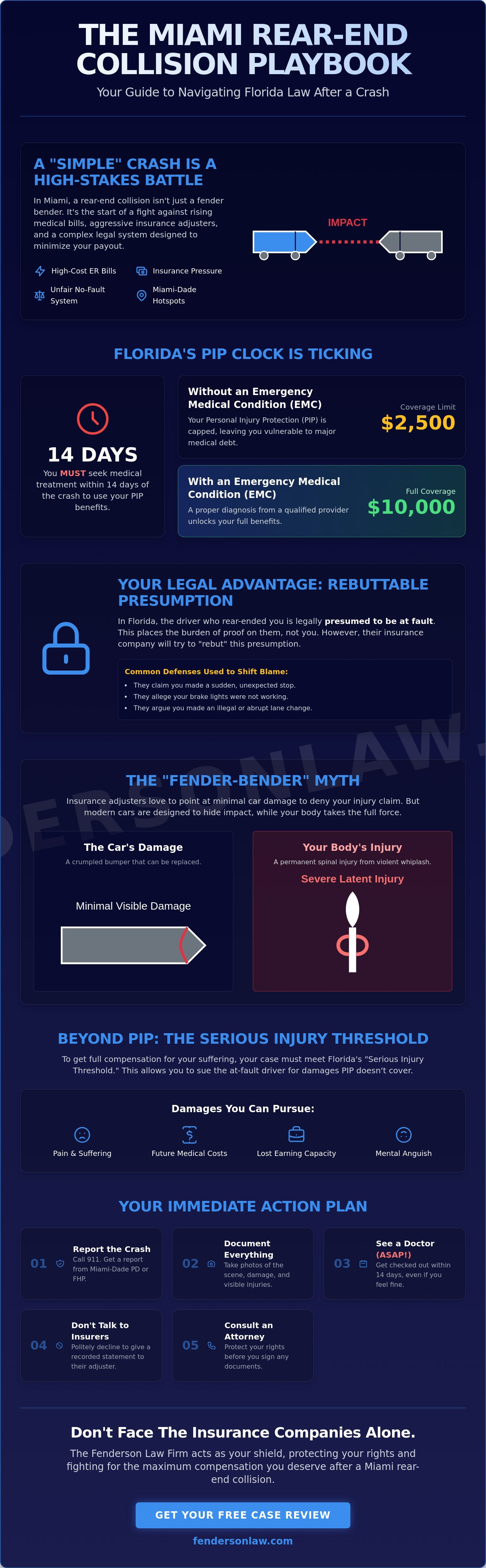
We're here to flip the script and act as your determined protector. You'll discover how to navigate Florida’s complex no-fault laws and secure the maximum compensation you deserve after a Miami rear-end crash. We will walk through the critical 14-day rule for PIP benefits, the importance of securing an Emergency Medical Condition diagnosis to unlock your full $10,000 in coverage, and how to step outside the no-fault system when your injuries meet the serious threshold. This is your roadmap to reclaiming your financial stability and your peace of mind.
Key Takeaways
- Learn why the rebuttable presumption in Florida law gives you an immediate legal advantage when another driver strikes your vehicle from behind.
- Understand why low-speed impacts on I-95 or the Palmetto Expressway often lead to permanent spinal injuries that insurance adjusters frequently dismiss.
- Discover how a Miami rear-end collision lawyer acts as a shield to help you overcome the $10,000 PIP limit and pursue maximum compensation.
- Identify the specific reporting requirements for the Miami-Dade Police Department and Florida Highway Patrol that are essential for your future claim.
- Master the legal criteria for the Serious Injury Threshold to determine if you can sue for non-economic damages like pain and suffering.
The Reality of Miami Rear-End Collisions in 2026
Miami's roads are a high-stakes environment where a split second of distraction leads to a lifetime of pain. The Palmetto Expressway and I-95 aren't just transit routes; they're hotspots for aggressive tailgating and sudden, violent stops. In 2026, the sheer volume of vehicles in Miami-Dade creates a pressure cooker for every driver. When you're struck from behind, the impact is more than physical. It's the shock of the metal-on-metal crash, the immediate fear of rising medical costs, and the deep frustration of dealing with a driver who simply wasn't paying attention. You aren't just a claim number. You're a neighbor whose life has been upended by someone else's negligence.
Immediate legal intervention is your only defense in a city that moves this fast. A seasoned Miami rear-end collision lawyer knows that in our digital age, the clock is ticking on your evidence. Dashcam footage, black box data from modern vehicles, and municipal surveillance are all subject to deletion or being overwritten within days. We step in as your warrior, freezing the record and ensuring the truth isn't buried under a pile of insurance paperwork. We act as a shield, protecting your future while you focus on your physical recovery.
Miami-Dade’s Most Dangerous Intersections for Rear-End Crashes
Stop-and-go congestion is the primary catalyst for crashes in Hialeah and the notorious Golden Glades Interchange. The constant braking in downtown Miami creates a dangerous environment where one distracted rideshare driver can trigger a multi-car chain reaction. With the massive increase in delivery fleets serving Brickell’s skyline, the risk of a rear-end collision is higher than ever. These high-traffic zones require a legal ally who understands local road patterns and the specific habits of Miami drivers. We know these streets because we live here, too.
Why "Minor" Property Damage Doesn’t Mean Minor Injuries
Don't fall for the "fender-bender" trap. Insurance companies love to point at a pristine bumper as proof that you aren't injured. The physics of whiplash tell a different story. While your car’s frame might absorb the shock, your body remains vulnerable to the violent "whip" of the head and neck. These latent injuries often take days or even weeks to manifest as chronic pain. If you wait too long to see a doctor, you risk losing your PIP benefits entirely. We guide you toward the right medical experts in Miami who can document these invisible but devastating injuries before the 14-day legal deadline expires.
Understanding Liability: The Rebuttable Presumption in Florida
Who is at fault when you're hit from behind? In Florida, the law provides a powerful starting point for your recovery. The rebuttable presumption of negligence means the court assumes the driver who struck you was the one at fault. This legal principle acts as your primary shield. It places the heavy burden of proof squarely on the rear driver’s shoulders. They must provide substantial evidence to prove they weren't negligent, which is a difficult task in the aggressive, fast-paced driving culture of Miami-Dade.
However, "rebuttable" means the presumption can be challenged. Insurance adjusters are trained to find any crack in your story to save their company money. They'll claim you stopped for no reason or that your brake lights were malfunctioning. They want to shift the blame to avoid paying the maximum compensation you deserve. This is why having a seasoned Miami rear-end collision lawyer is non-negotiable. We act as your protector, anticipating these defensive tactics and gathering the evidence needed to shut them down immediately.
When the Rear Driver Can Challenge Fault
Miami traffic is notoriously volatile. The defense may argue that a "sudden and unexpected stop" occurred. But in places like Kendall or Hialeah, what counts as "unexpected"? Florida courts generally rule that stopping for heavy traffic or a pedestrian isn't unforeseeable. If the lead driver makes an illegal maneuver, such as an abrupt lane change without signaling, the court might apply Florida’s modified comparative negligence standard. If you're found more than 50% at fault, you're barred from recovery. We ensure the facts are presented so you stay on the right side of that line.
Proving Negligence Beyond the Presumption
We don't just rely on legal assumptions; we build an airtight case with concrete data. In 2026, digital evidence is the most effective weapon in a legal struggle. We aggressively pursue every available lead to reinforce your claim:
- Dashcam and Surveillance: We secure footage from your vehicle, surrounding drivers, and municipal cameras at high-risk intersections.
- Digital Footprints: We analyze cell phone records to determine if the rear driver was distracted by a screen at the moment of impact.
- Mechanical Inspections: We investigate if a third party, like a negligent mechanic, contributed to a brake failure.
While Florida Statute 627.736 dictates how your initial PIP benefits are handled, it doesn't resolve the ultimate question of who is responsible for your long-term suffering. Our firm stands as a formidable barrier against insurance companies that try to exploit these nuances. We hold the at-fault party accountable, ensuring they pay for the damage they've caused to your life and your future.
Beyond PIP: Maximizing Your Compensation Under Florida Law
Did you know your $10,000 Personal Injury Protection (PIP) coverage could vanish before you even leave the hospital? In 2026, a single emergency room visit at a Miami-Dade facility typically costs between $2,500 and $5,000 before any imaging or specialist fees are added. Because PIP only covers 80% of your medical bills and 60% of lost wages, you're immediately left with a financial deficit. A Miami rear-end collision lawyer acts as your shield, ensuring that "no-fault" doesn't mean "no recovery" for the damages that exceed these minor limits.
We look at your recovery through the lens of long-term guardianship. Your claim isn't just about today's bills; it's about the future rehabilitative care you may need for years to come. Under Florida Statute 316.0895, drivers must maintain a safe following distance. When they violate this law and strike you, they're responsible for the full scope of your hardship. We aggressively pursue compensation for every dollar lost, from immediate surgical costs to the wages you'll lose while recovering at home in Coral Gables or Kendall.
Meeting the Serious Injury Threshold
To step outside Florida’s no-fault system and sue for pain and suffering, you must meet the "serious injury threshold." This legal gateway requires proving a permanent injury, significant scarring, or the permanent loss of a bodily function. Insurance adjusters will try to categorize your spinal trauma as a "temporary soft tissue injury" to avoid a payout. We don't let them. We use expert medical testimony from specialized Miami physicians to document the permanent nature of your back and neck trauma, breaking past the no-fault barrier to secure the justice you deserve.
Dealing with Underinsured or Uninsured Motorists
What happens if the driver who slammed into you on the Palmetto Expressway is one of the thousands of Florida motorists with no insurance? In our state, Bodily Injury Liability isn't legally required for most drivers, which creates a massive risk for you. When the at-fault party is underinsured, your own Uninsured Motorist (UM) policy becomes your primary safety net. We fight your own insurance company with the same ferocity we use against legal adversaries to ensure they honor the protection you've paid for. For every Miami commuter, UM coverage is the essential armor that prevents a single crash from causing a total financial collapse.
Steps to Take After a Rear-End Collision in Miami
The seconds following a crash on the MacArthur Causeway or a chaotic Hialeah intersection are a blur of adrenaline and confusion. Your first instinct might be to apologize or check if the other driver is okay. Don't. In the eyes of an insurance adjuster, a simple "I'm sorry" is a recorded admission of fault that they will use to dismantle your claim. You must remain calm and prioritize your legal safety. Call 911 immediately to ensure either the Miami-Dade Police Department (MDPD) or the Florida Highway Patrol (FHP) arrives to create an official crash report. This document is the bedrock of your case, providing an objective account of the scene before memories fade or stories change.
Time is your greatest enemy in Florida. The "14-Day Rule" is a strict mandate that requires you to seek initial medical services within two weeks of the accident. If you miss this window, you forfeit your right to Personal Injury Protection (PIP) benefits entirely. Even if you feel fine, the latent nature of spinal injuries means you could be internalizing damage that won't manifest for days. A seasoned Miami rear-end collision lawyer will ensure you meet every deadline and secure the medical documentation necessary to protect your right to compensation. Don't let a technicality destroy your chance at justice.
Documenting the Scene Like a Pro
Your smartphone is your most powerful tool for gathering evidence. Capture high-resolution photos of vehicle positioning, skid marks, and any obscured street signs that may have contributed to the crash. Don't just write down the other driver's information. Take clear photos of their driver’s license, insurance card, and license plate to prevent transcription errors. This digital trail makes it impossible for the at-fault party to deny their presence or provide false details later. For a deeper look at protecting your claim, read our guide on Injured? 5 Critical Steps After a Florida Car Accident.
Communicating with Insurance Adjusters
Expect a phone call from an insurance adjuster within 24 hours of the crash. They may sound empathetic, but their goal is to minimize your payout. They'll ask for a "recorded statement" to get your side of the story. This is a trap. They're looking for any inconsistency or casual remark to suggest your injuries aren't serious. They'll point to "minor damage" in photos to argue that your physical pain is exaggerated. Never sign anything or accept a first settlement offer without legal review. These initial offers are almost always lowball attempts to close your file for pennies on the dollar. Before you speak to any adjuster, contact a Miami rear-end collision lawyer to act as your shield and handle all communications on your behalf.
Why Fenderson Law Firm is Your Shield in Miami
Are you ready to stop being a victim and start being a victor? In the high-stakes legal environment of 2026, you need more than just a legal representative. You need a Miami rear-end collision lawyer who acts as a tireless warrior for your future. We don't just settle for what the insurance company offers; we fight for every cent you're owed. Our firm is built on the principle of aggressive advocacy, standing as a formidable barrier between you and the corporate entities that want to minimize your pain. When you choose our team, you're choosing a seasoned ally who understands the high stakes of Florida's modified comparative negligence laws.
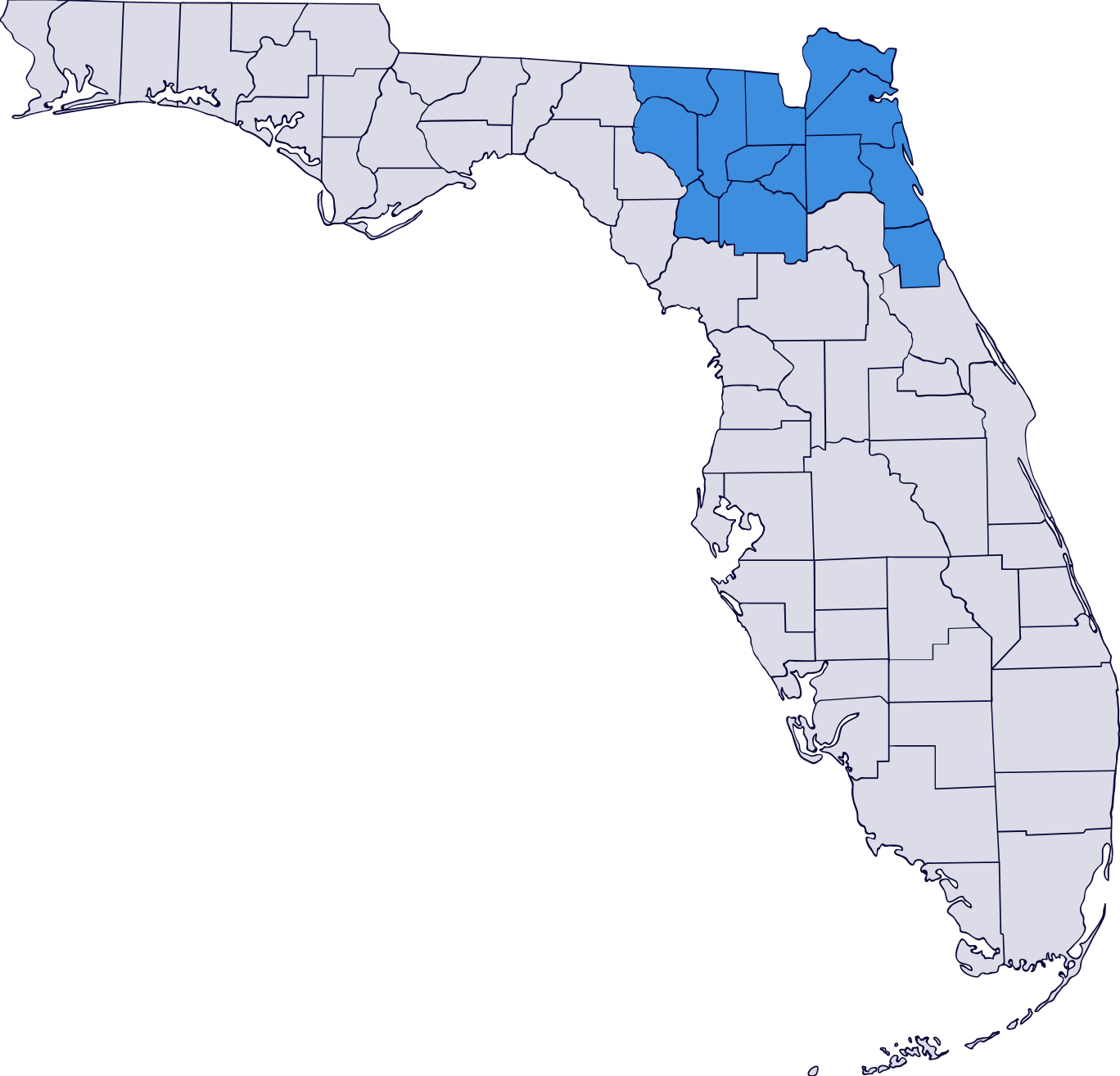
Our regional expertise is your greatest asset. We possess a deep, localized understanding of Miami-Dade courts, the specific habits of local adjusters, and the unique traffic patterns of our city. This isn't a general practice. It's a focused, high-intensity mission to secure justice for our neighbors. We maintain an unwavering commitment to the people of Florida, serving clients with excellence in Miami, Orlando, Tampa, and Jacksonville. No matter where you are in the Sunshine State, our protection is within your reach. Distance is never a barrier to the high-quality representation you deserve.
Financial fear shouldn't be a barrier to justice. That's why we offer the Fenderson Guarantee. You won't pay a single dollar in fees or costs unless we win your case. This performance-based promise ensures that our interests are perfectly aligned with yours. We take on the financial risk so you can focus on the physical and emotional work of healing. We're your long-term guardians, invested in your recovery from the moment you call us until the final check is in your hand.
A Determined Protector for Your Recovery
We strike a deliberate balance between being aggressive toward legal adversaries and remaining deeply compassionate toward you. While we're a seasoned warrior in the courtroom, we're a supportive ally in your living room. We handle the heavy lifting, including the paperwork, the phone calls, the medical liens, and the negotiations, so you don't have to. If you're looking for a Personal Injury Lawyer Near Me: Your Florida Shield for Justice in 2026, you've found the firm that treats your crisis with the urgency it deserves.
Schedule Your Free Miami Case Evaluation
What happens during your first consultation? We move quickly to identify the strengths of your case. Our team analyzes your Miami-Dade crash report, scrutinizes your medical records, and identifies every potential source of insurance coverage. We build a winning strategy from day one, offering a clear understanding of your legal standing and your path to compensation. Take the first step toward reclaiming your life today. No distance is too far for us to travel to ensure a fair outcome for our clients. Your recovery is our mission, and we won't rest until justice is served.
Take Command of Your Recovery Today
Your journey from victim to victor starts with a single decision. You've learned that Florida’s rebuttable presumption of fault is a powerful tool, but it requires a warrior to wield it effectively against aggressive insurance adjusters. You also know that the $10,000 PIP limit is often just a drop in the bucket compared to actual Miami medical costs. This makes it vital to break through the serious injury threshold with expert legal guidance to secure the full compensation you deserve. Whether you were hit in Brickell, Hialeah, or on the Palmetto Expressway, your rights deserve a dedicated protector who understands the local landscape.
With over 15 years of aggressive Florida advocacy and a no-win, no-fee financial guarantee, we provide the dedicated representation you need across Miami-Dade County. Don't let an insurance company dictate the value of your future. A seasoned Miami rear-end collision lawyer from our team will act as your shield, handling the legal struggle so you can focus on healing. Contact Fenderson Law Firm today for a free consultation; we don’t get paid unless you win. You aren't alone in this fight, and the justice you deserve is within reach.
Frequently Asked Questions
Is the driver who rear-ended me always at fault in Miami?
No, the rear driver isn't always at fault, though Florida law starts with that assumption. This is known as a rebuttable presumption. The rear driver can challenge this by proving the lead driver made an illegal maneuver or had non-functioning brake lights. However, the burden of proof rests on them. We act as your shield to ensure their excuses don't undermine your claim for justice.
How much is a typical rear-end collision settlement in Florida?
Settlement amounts depend entirely on the unique facts of your case. There's no typical amount because compensation is based on your specific medical bills, lost wages, and the permanence of your injuries. A minor fender-bender results in a different recovery than a high-speed crash on I-95. We analyze your medical records and the serious injury threshold to calculate the maximum value of your claim.
Can I still recover damages if I was partially at fault for the crash?
You can recover damages as long as you're 50% or less at fault. Florida follows a modified comparative negligence standard. If a jury finds you 20% responsible for the crash, your total compensation is reduced by 20%. But if your fault exceeds 50%, you're legally barred from recovering any damages from the other party. We fight aggressively to keep your liability percentage as low as possible.
What if the person who hit me doesn’t have insurance?
If the at-fault driver is uninsured, you'll rely on your own insurance policy. Your PIP coverage handles the first $10,000 in medical bills and lost wages. Beyond that, your Uninsured Motorist (UM) coverage acts as a critical safety net. Since Bodily Injury Liability isn't required for most Florida drivers, having a Miami rear-end collision lawyer investigate all available insurance avenues is essential for your financial recovery.
How long do I have to file a lawsuit after a rear-end accident in Miami?
For accidents occurring on or after March 24, 2023, you have two years to file a personal injury lawsuit. This is a significant change from the previous four-year limit. If you're only suing for property damage, the limit remains four years. Missing these deadlines permanently bars you from seeking justice, so it's vital to act with a sense of urgency and secure legal counsel immediately.
Do I need a lawyer if the insurance company already offered me a settlement?
You should always consult a professional before signing any insurance documents. Insurance adjusters often rush to offer a quick settlement before the full extent of your spinal or neck injuries is known. These early offers rarely cover long-term rehabilitative care. A Miami rear-end collision lawyer evaluates the offer against your actual needs to ensure you aren't leaving money on the table that you'll need for future treatment.
What should I do if my neck starts hurting a week after the accident?
You must seek medical attention immediately to protect your health and your legal rights. Florida’s 14-day rule requires you to receive initial medical care within two weeks of the crash to qualify for PIP benefits. Many rear-end injuries, like whiplash or disc herniations, don't show symptoms right away. Waiting too long to see a doctor can result in a total denial of your insurance claim and your benefits.
How does Florida’s no-fault law affect my rear-end collision claim?
Florida’s no-fault system requires you to use your own PIP coverage first, regardless of who caused the accident. This covers 80% of medical bills and 60% of lost wages up to $10,000. To sue the at-fault driver for pain and suffering, your injuries must meet the serious injury threshold. This includes permanent loss of a bodily function, significant scarring, or permanent injury within a reasonable degree of medical probability.


