
What if a single percentage point stood between you and the financial recovery you deserve? In Jacksonville, the no-fault label often creates a dangerous sense of security. You might believe your insurance handles everything, but the reality is much harsher. Under current Florida at-fault car accident laws, being found 51% responsible for a collision now bars you from recovering any damages at all. This shift to a modified comparative negligence system means insurance companies are looking for any reason to shift the blame onto you.
It's exhausting to fight for your health while worrying about rising medical bills and aggressive adjusters. We understand that your future feels like it's under siege. This guide provides the clarity you need to navigate these complex legal shifts. You'll learn how the Serious Injury Threshold works, why the 14-day medical rule is non-negotiable, and how to safeguard your rights within the two-year statute of limitations. From the busy streets of Duval County to the high-traffic corridors of Miami and Orlando, we're breaking down exactly how to secure the justice you're owed.
Key Takeaways
- Understand how PIP covers your first $10,000 in medical costs and when it's time to look beyond your own policy for justice.
- Are you more than 50% at fault? Learn how Florida’s 51% rule could strip away your right to any compensation.
- Master the specifics of Florida at-fault car accident laws to navigate high-risk areas like Jacksonville’s I-95 interchanges and Orlando’s tourist-heavy roads.
- Identify the "Serious Injury Threshold" requirements that allow you to sue for non-economic damages like pain and suffering.
- Discover how a results-driven legal ally shields you from insurance company blame-shifting to secure your financial future.
Florida No-Fault vs. At-Fault: Clearing the Confusion
Florida's insurance system is often misunderstood as a total shield against liability. It isn't. While the state mandates a no-fault approach to initial medical coverage, the reality of Florida at-fault car accident laws becomes painfully clear the moment your medical bills exceed a few thousand dollars. In major hubs like Jacksonville, Orlando, and Miami, a single trip to the emergency room can exhaust your basic coverage before you even leave the hospital. We've seen how insurance adjusters use this confusion to minimize their payouts, leaving victims to shoulder the weight of a crisis they didn't cause.
The Role of PIP Insurance in 2026
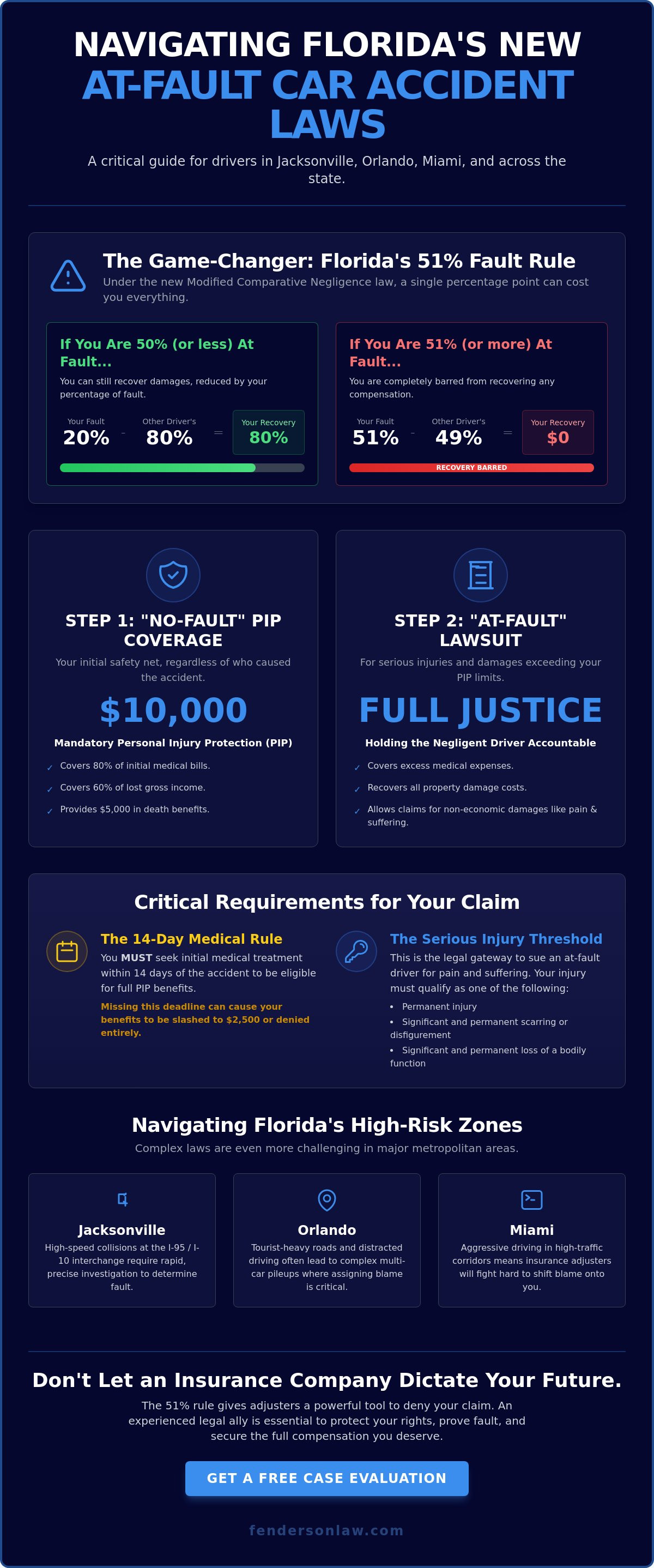
Every driver on Florida roads must carry $10,000 in Personal Injury Protection (PIP). This coverage acts as an immediate financial safety net, paying for your needs regardless of who caused the wreck. However, PIP is limited in scope and strictly regulated. To trigger these benefits, you must adhere to the following:
- The 14-Day Rule: You must seek initial medical treatment within 14 days of the accident. Failure to do so can result in your benefits being slashed to $2,500 or denied entirely.
- Coverage Limits: PIP typically covers 80% of necessary medical expenses and 60% of lost gross income, up to the $10,000 policy limit.
- Death Benefits: The policy provides $5,000 in death benefits if the accident results in a fatality.
PIP is designed to reduce the number of small claims in the court system, but it rarely covers the true cost of a significant collision in modern Florida cities. When your recovery requires surgery, long-term physical therapy, or extended time away from work, that $10,000 disappears almost instantly. This financial gap is a challenge for accident victims nationwide; for instance, in New York, Yakov Mushiyev & Associates, P.C. provides the same level of dedicated advocacy for those struggling to cover their post-crash expenses.
Why "At-Fault" Still Matters for Your Lawsuit
The "no-fault" designation only applies to your initial insurance claim; it doesn't limit your legal right to demand full justice. When a negligent driver strikes you on the I-95/I-10 interchange in Jacksonville or a distracted motorist causes a pile-up in Orlando, you are not trapped by PIP. For property damage and medical expenses that surpass your policy limits, Florida functions as an at-fault state.
Determining liability is essential because it dictates who is financially responsible for your long-term recovery. Florida uses a system of comparative negligence to assign blame and calculate payouts. If the other party is primarily responsible, they are on the hook for your excess bills and non-economic losses. The Serious Injury Threshold serves as the legal gateway, requiring proof of permanent injury, significant scarring, or loss of a bodily function before you can sue an at-fault driver for pain and suffering. We refuse to let insurance companies hide behind the "no-fault" label while you suffer. Our firm acts as a formidable ally, ensuring the responsible party pays for every dollar of damage they inflicted on your life.
Florida's 51% Rule: Modified Comparative Negligence Explained
For decades, Florida operated under a "pure" comparative negligence system. This meant you could be 90% responsible for a crash and still recover 10% of your damages. That era ended in 2023. The legal landscape has shifted dramatically, and many online resources are dangerously outdated. Under the current Florida at-fault car accident laws, the state now follows a "modified" comparative negligence standard. This change is a powerful weapon for insurance companies, and you need to understand how it works to protect your financial future.
Calculating Percentage of Fault
In the aftermath of a collision, investigators don't just look at who hit whom. They dissect every second leading up to the impact. Whether you are navigating the heavy traffic of Jacksonville's Southside or the tourist-heavy corridors of Orlando, every detail matters. Determining fault involves a forensic look at dashcam footage, witness statements, and vehicle "black box" data. Following Florida's official crash reporting requirements is the first step in ensuring an accurate record exists. In a multi-car pileup, a jury might decide you were 20% at fault for speeding, while the other driver was 80% at fault for an illegal lane change. In this scenario, your total compensation is simply reduced by your 20% share of the blame.
The Consequences of the 51% Threshold
The 51% bar is the most aggressive hurdle victims face today. If you are found to be 51% or more at fault, you are legally barred from recovering a single penny from the other party. It is a total loss. Insurance adjusters know this. They'll dig through your social media, misinterpret your recorded statements, and twist the facts to push your liability just over that 50% line. A finding of 49% fault means you still receive 51% of your damages; a finding of 51% fault means you receive zero. This rule protects defendants and large insurance corporations more than ever before. We act as a formidable shield against these tactics, fighting to ensure you aren't unfairly blamed for a crisis you didn't create. If you're worried about how these percentages might impact your claim, it's time to speak with a Florida accident attorney who understands the high stakes of these new regulations.
Determining Fault in Florida Cities: Local Factors
The geography of your accident is just as important as the physics of the impact. While Florida at-fault car accident laws provide a statewide framework, the way fault is assigned often depends on the specific street or highway where the crash occurred. A jury in Jacksonville views a merging accident on the I-95/I-10 interchange differently than a jury in Miami views a high-speed collision on the Palmetto Expressway. We dissect these local traffic patterns to ensure your story isn't lost in a generic police report. Our firm acts as a shield, protecting you from adjusters who don't understand the unique dangers of our local roads.
Jacksonville and North Florida Traffic Realities
Jacksonville’s massive footprint creates specific hazards, particularly in Duval County construction zones where lane shifts are constant and poorly marked. In these areas, fault disputes often center on "failure to yield" versus "speeding." If you were struck while merging near the St. Johns River, the defense will likely claim you were the aggressive party. We counter these accusations by analyzing local traffic camera data and site-specific signage. For those facing the aftermath of a North Florida wreck, our Car Accident Lawyer Jacksonville FL team provides the localized advocacy needed to win. We know these roads because we drive them every day.
Orlando Tourist Zones and Distracted Driving
Orlando presents a unique challenge: the "unfamiliar driver" factor. Near Disney, Universal, and the International Drive corridor, Orange County roads are filled with tourists navigating via GPS. This leads to sudden stops, illegal U-turns, and extreme distracted driving. When a rental car is involved, liability becomes even more complex. A deep understanding of Florida car accident laws is required to hold these transient drivers and their insurance carriers accountable. In tragic cases involving fatal collisions in these high-traffic zones, an Orlando Wrongful Death Lawyer is essential to protect your family’s future and secure the justice you deserve.
Miami and Tampa offer their own set of risks. In Miami, the aggressive driving culture often forces a re-examination of "reasonable care" standards. What is considered a standard lane change elsewhere might be seen as a defensive necessity there. Meanwhile, Tampa’s Howard Frankland Bridge is a frequent site for chain-reaction pileups. In these multi-car scenarios, assigning a percentage of fault is a high-stakes battle. We refuse to let you become a statistic in a multi-car dispute. Whether you were hit on a bridge in Tampa or a boulevard in Miami, we fight to ensure the 51% rule doesn't bar your recovery.
The Serious Injury Threshold: When Can You Sue?
If you've been injured in a collision, the $10,000 provided by your PIP coverage is often just a down payment on a mountain of debt. To truly hold a negligent driver accountable for the chaos they've caused, you must cross a specific legal line. Under Florida at-fault car accident laws, you cannot pursue non-economic damages like pain, suffering, or mental anguish unless your injuries meet the "Serious Injury Threshold." This barrier exists to protect insurance companies from smaller claims, but it shouldn't be used to silence victims with life-altering trauma. We refuse to let a technicality stand between you and the justice you deserve.
What Qualifies as a "Serious Injury"?
Florida Statute 627.737 defines exactly what kind of damage allows you to step outside the no-fault system. It isn't enough to feel pain; you must prove your injury has a lasting impact on your existence. The law recognizes four primary categories:
- Significant and permanent loss of an important bodily function: This involves injuries that prevent you from living as you did before the wreck.
- Permanent injury within a reasonable degree of medical probability: This requires expert medical testimony to confirm the damage won't fully heal.
- Significant and permanent scarring or disfigurement: This is often a critical factor in motorcycle or high-impact truck accidents.
- Death: In these tragic instances, the family pursues a wrongful death claim to secure their future.
Proving "permanency" is a battle of experts. Insurance adjusters will hire their own doctors to downplay your suffering. Our firm acts as a shield, documenting your recovery from day one and coordinating with medical professionals who can articulate the true extent of your loss to a jury.
Seeking Damages Beyond PIP
Once you cross that threshold, the financial landscape changes. You are no longer limited to the 80% medical coverage PIP provides. You can pursue the at-fault driver for 100% of your medical bills, lost gross income, and the cost of future care. This is where Bodily Injury Liability (BI) coverage becomes vital. Because Florida doesn't mandate BI coverage for all drivers, finding the money to cover your recovery is often a complex hunt for assets or underinsured motorist benefits. We aggressively track down every available dollar to ensure your lost future earning capacity is fully restored. If you're struggling to understand how your injuries fit into these complex regulations, it's time to consult with a car accident legal representative who knows how to break through the insurance company's defenses.
Protecting Your Future: Why a Florida Accident Lawyer is Essential
Evidence on Florida roads disappears with terrifying speed. Skid marks fade under the blistering sun. Traffic camera footage is overwritten in days. Witnesses lose the sharp clarity of their memories. When you're facing the weight of Florida at-fault car accident laws, delay is your greatest enemy. Insurance corporations are already moving to build a case against you, deploying adjusters and investigators to find any reason to deny your claim. You need a formidable ally who moves just as fast to preserve the truth and lock in the evidence that proves your innocence.
Aggressive Advocacy Against Insurance Giants
Insurance adjusters are trained to set traps. They'll call you under the guise of "checking in," hoping to catch you in a recorded statement that they can later twist to meet the 51% fault threshold. One misplaced word about your speed or a momentary distraction can shatter your chance at recovery. We know their playbook. Our firm shatters these tactics by taking over all communication, ensuring that your rights are never compromised by aggressive blame-shifting. Whether your case unfolds in the courtrooms of Jacksonville, the busy districts of Orlando, the coastal hubs of Miami, or the growing suburbs of Tampa, we bring a winning image and deep regional expertise to the table. If you're searching for a Personal Injury Lawyer Near Me, you deserve a team that acts as a shield for your future.
Your Shield in the Legal Storm
Our commitment to your recovery is a long-term guardianship. We don't just process paperwork; we dismantle the obstacles that stand between you and justice. We operate on a performance-based promise: you don't pay us unless we win your case. This financial guarantee ensures that every victim has access to high-stakes legal representation, regardless of their current financial crisis. We are tireless, hardworking, and omnipresent across the state. No distance is too far to ensure a fair outcome for our clients. We stand ready to represent you in:
- Jacksonville and the surrounding Duval County suburbs.
- Orlando, including Kissimmee and the tourist corridors.
- Tampa, St. Petersburg, and the entire Bay Area.
- Miami, Fort Lauderdale, and the South Florida coast.
Your recovery shouldn't be limited by insurance company tactics or a fear of the legal system. You've suffered enough. It's time to let a seasoned warrior take the lead and fight for the maximum compensation you deserve under the law. Contact Fenderson Law Firm for your free consultation today.
Take Back Control of Your Recovery
Are you ready to stop insurance companies from dictating your future? The complexities of Florida at-fault car accident laws mean that a single mistake in a recorded statement could end your claim forever. We've seen how the 51% fault rule acts as a trap for the unwary and how the serious injury threshold is used to minimize real human suffering. You don't have to face this legal storm alone. Our firm understands that your recovery is about more than just medical bills; it's about reclaiming your life and your liberty.
Since 2010, we've stood as a shield for victims across Jacksonville, Orlando, Tampa, and Miami. Our firm is built on a performance-based promise; you won't pay a single fee unless we win your case. Whether you're navigating the aftermath of a crash in Duval County or the busy streets of South Florida, our localized expertise is your greatest asset. We act as your long-term guardian, fighting aggressively to ensure your recovery is full and fair. We refuse to let distance or legal complexity stand in the way of your justice.
Get the Aggressive Advocacy You Deserve. Schedule Your Free Consultation Now. Your path to justice starts today, and we're with you every step of the way.
Frequently Asked Questions
Is Florida still a no-fault state for car accidents in 2026?
Yes, Florida remains a no-fault state regarding your initial medical coverage. This means your own Personal Injury Protection (PIP) insurance is the primary source of payment for your medical bills and lost wages, up to the $10,000 limit, regardless of who caused the crash. However, for damages that exceed these limits or for non-economic losses, Florida at-fault car accident laws allow you to pursue a claim against the negligent driver.
What happens if I am 50% at fault in a Florida car accident?
You can still recover damages if you are exactly 50% at fault for the collision. Under the current modified comparative negligence rule, you are only barred from financial recovery if your responsibility exceeds 50%. If a jury finds you 50% liable, your total compensation is simply reduced by half. For example, a $100,000 award would be reduced to $50,000. This makes every percentage point in the investigation critical to your final payout.
Can I sue the other driver if my medical bills exceed $10,000?
Yes, you can pursue the other driver for medical expenses that surpass your $10,000 PIP limit. While PIP covers 80% of your initial bills, it often fails to account for the true cost of surgery or long-term care in cities like Jacksonville or Miami. You can sue for these excess economic damages regardless of the severity of your injury. To seek additional compensation for pain and suffering, however, you must also meet the state's serious injury threshold.
How is fault determined if there were no witnesses to the crash?
Fault is determined through a forensic analysis of physical evidence when no eye-witnesses are available. Investigators examine skid marks, vehicle crush patterns, and data from the car's event data recorder, also known as a black box. In high-traffic areas like Orlando or Tampa, we also utilize footage from nearby traffic cameras or private security systems. This objective data often provides a clearer picture of the collision than a fallible human memory ever could.
Does the police report determine who is legally at fault in Florida?
No, a police report is not the final determination of legal fault in a civil lawsuit. While officers provide an initial assessment and may issue citations, their report is generally inadmissible as evidence in a Florida courtroom. Fault is ultimately decided by insurance adjusters during negotiations or by a jury at trial. We often challenge police reports that contain inaccuracies or fail to account for the other driver's hidden negligence.
What is the "Serious Injury Threshold" under Florida law?
The Serious Injury Threshold is a legal standard that requires proof of a permanent injury to sue for non-economic damages. Under Florida at-fault car accident laws, this includes significant and permanent scarring, loss of a bodily function, or a permanent injury within a reasonable degree of medical probability. Crossing this threshold is essential for recovering compensation for the emotional and physical trauma that basic PIP insurance simply does not cover.
How long do I have to file an at-fault car accident claim in Florida?
You generally have two years from the date of the accident to file a personal injury lawsuit in Florida. This statute of limitations is strict; missing the deadline usually means you lose your right to seek compensation forever. While two years may seem like a long time, building a winning case requires immediate action to preserve evidence and secure expert testimony before the clock runs out on your justice.
Can I still recover money if I was not wearing a seatbelt during the accident?
Yes, you can still recover money, but your compensation may be reduced under the seatbelt defense. The defense will argue that your failure to wear a seatbelt contributed to the severity of your injuries. If they prove this, a jury can assign you a percentage of fault for your own damages. This is why aggressive representation is vital to ensure you aren't unfairly penalized for factors that didn't cause the actual collision.


