
In Florida, your evidence isn't just a collection of paperwork; it's the only shield standing between your family's financial future and an insurance company's aggressive tactics. Whether you're recovering in Jacksonville, Orlando, Tampa, or Miami, you're likely feeling the crushing weight of rising medical debt and the fear that you'll be unfairly blamed for the accident. Florida's modified comparative fault rules mean that being even slightly over the 50 percent fault threshold can completely bar you from recovery. You must understand exactly what evidence is needed for a personal injury claim in Florida to defend your rights and prove the other party's negligence.
We recognize the anxiety of lost wages and the confusion of a legal system that recently slashed the statute of limitations to just two years. You deserve a seasoned ally who views your recovery as a mission, not just a case. This article provides a clear checklist of the specific proof you must gather to secure a maximum settlement and protect your long term stability. We'll explore how to document your physical injuries and navigate the PIP system so you can confront these powerful entities with absolute confidence and strength.
Key Takeaways
- Learn why evidence acts as your primary legal shield against insurance companies trying to exploit Florida's complex modified comparative fault rules.
- Discover exactly what evidence is needed for a personal injury claim in Florida, ranging from immediate visual proof at the scene to a comprehensive paper trail of your financial losses.
- Understand the vital distinction between proving liability and documenting damages to ensure you are fully compensated for medical bills and lost wages.
- Gain local insights on securing evidence across Jacksonville, Orlando, Tampa, and Miami, including how to obtain JTA bus footage or resort security records.
- See how aggressive legal advocacy protects your rights before the strict two-year statute of limitations expires and evidence begins to disappear.
Why Evidence is the Foundation of Your Florida Personal Injury Claim
Why do insurance giants in cities like Tampa or Miami try to minimize your pain? Because they can. Without a fortress of proof, your claim is just your word against their bottom line. Evidence serves as the definitive shield that prevents these companies from devaluing your struggle. In the high-stakes arena of personal injury law, the burden of proof rests entirely on your shoulders. You must act as the aggressor in gathering facts to secure a maximum recovery for your medical bills and lost wages. If you don't present a mountain of facts, you're essentially leaving your financial recovery to chance. We don't accept that.
The Burden of Proof in Florida Courts
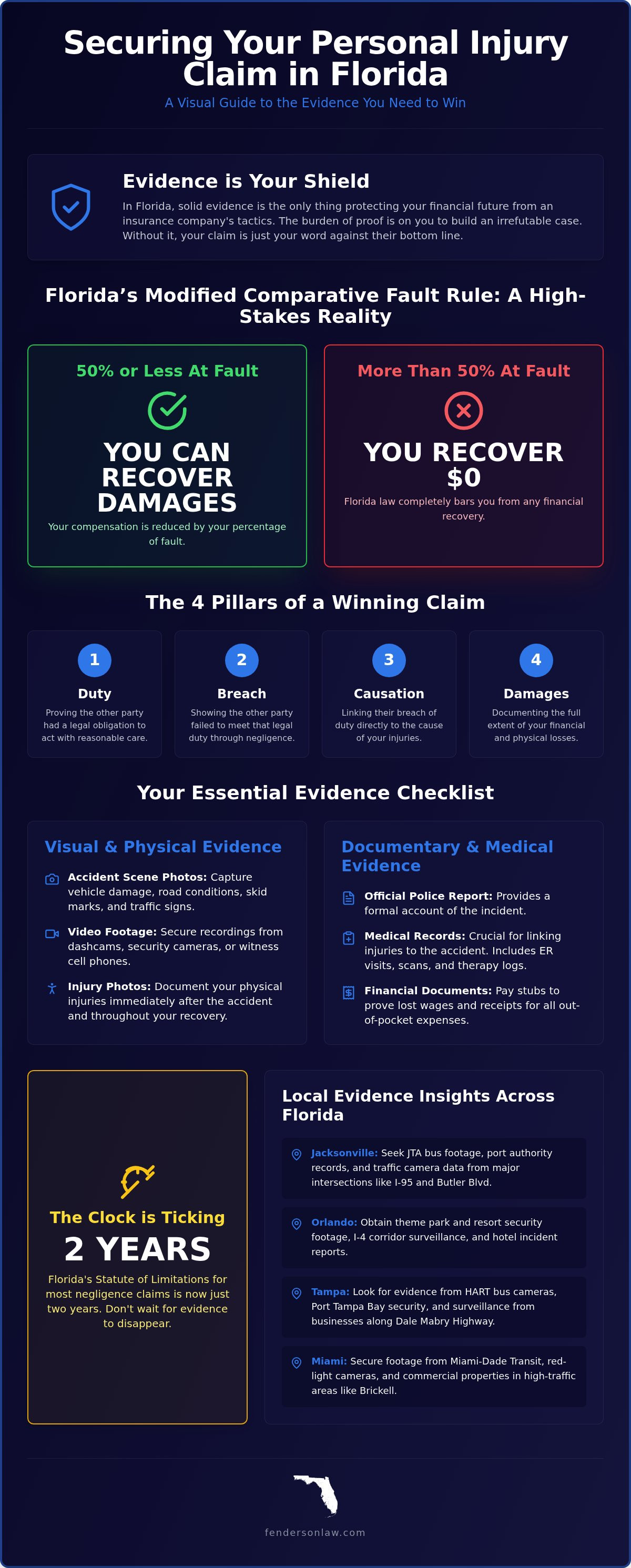
Florida courts operate on a "preponderance of the evidence" standard. This means you don't need to prove your case beyond a reasonable doubt; you just need to show it's more likely than not that the defendant is responsible. To win, you must establish four critical pillars: duty, breach, causation, and damages. Whether you were struck on a busy street in Jacksonville or injured in an Orlando resort, you need a clear narrative. Strong documentation creates an irrefutable story that forces the opposition to face the truth. Understanding exactly what evidence is needed for a personal injury claim in Florida is the first step toward building this legal fortress. With the statute of limitations for negligence now shortened to just two years as of March 24, 2023, there's no time for hesitation. Every second you wait is a second the evidence could disappear.
Florida’s Modified Comparative Fault Rule
Why is the "blame game" so dangerous for victims in Florida? Since recent tort reforms, the state follows a modified comparative fault system. If a jury decides you're more than 50 percent responsible for your own injuries, you recover nothing. Zero. This harsh reality makes evidence your most valuable asset. It allows us to shift the focus back to the negligent party's failures. By meticulously documenting the scene and the other driver’s actions, we protect your right to compensation. We won't let an insurance adjuster in Miami or a defense lawyer in Tampa twist the facts to push you over that 50 percent threshold. Your future depends on a legal shield that refuses to buckle under pressure. We fight to ensure that every percentage of fault is accurately attributed so your settlement remains intact. Distance is no barrier; we represent clients across the state with the same relentless intensity.
The Four Pillars of Evidence: Building an Irrefutable Case
Winning isn't about luck; it's about data. When you're up against an insurance adjuster in Miami or a corporate defense team in Orlando, you need a foundation that can't be shaken. Identifying exactly what evidence is needed for a personal injury claim in Florida transforms a weak case into an unstoppable force. We view every piece of proof as a brick in the wall that protects your future. If you've been injured on a congested Tampa highway or a busy street in Jacksonville, you must act fast. Evidence has a shelf life, and once it's gone, the insurance company will use that void to blame you. We don't let that happen.
Physical and Visual Evidence
Photos are your most immediate weapon. High-resolution images of shattered glass, twisted metal, and road conditions tell a story that words cannot. Don't just photograph the cars; capture the "silent witnesses" like skid marks or obstructed stop signs. If you have visible injuries, document them immediately and throughout your recovery. Modern cases often hinge on video. Dashcams, doorbell cameras, and commercial surveillance footage provide an objective account of the impact. If you're unsure how to secure these records, our team of personal injury advocates can step in as your shield to ensure this footage isn't overwritten.
Documentary and Medical Evidence
Medical records are the heart of your claim. According to a Personal Injury Law Guide, documenting every medical interaction is essential for proving the link between the accident and your suffering. This isn't just about the ER visit. It includes physical therapy logs, diagnostic scans, and specialist notes that prove the extent of your damages. Police reports provide a formal framework, but they aren't always the final word. We look deeper, cross-referencing accident reports with your financial records to prove lost wages and lost future earning capacity. This paper trail is what forces insurance companies to pay what you're actually owed.
Digital Evidence and Social Media
Digital proof is the new standard for accident reconstruction. Modern vehicles and commercial trucks carry "black box" data that records speed, braking, and steering at the moment of impact. Cell phone records can also be subpoenaed to prove a driver was distracted by a text or call. However, digital evidence is a double-edged sword. Your own social media posts can be weaponized against you. A single photo of you smiling at a family dinner in Tampa can be used to argue that your injuries aren't as severe as you claim. We advise our clients to stay off social media while we build their case, keeping the digital focus entirely on the negligent party's failures.
Proving Liability vs. Damages: The Florida Legal Standard
Is it enough to just show you're hurt? No. In the eyes of Florida law, an injury without proven fault is a tragedy, but it isn't a legal claim. Conversely, proving someone else was reckless in Tampa or Orlando means nothing if you can't document your losses. A successful case requires a bridge between liability and damages. Understanding exactly what evidence is needed for a personal injury claim in Florida means knowing how to connect the "who" to the "how much." We act as that bridge, using aggressive investigation to ensure neither pillar collapses under the weight of insurance company denials. You need both a fortress of fault and a mountain of loss to secure the justice you deserve.
Establishing Liability (Fault)
Proving liability means showing the other party breached their duty of care. Whether it's a truck driver on I-95 in Jacksonville or a distracted driver in Miami, we use traffic laws as our roadmap. Witness statements from bystanders in suburbs like Coral Gables or Hialeah provide a neutral perspective that often breaks a "he-said, she-said" stalemate. When the sequence of events is murky, we bring in accident reconstruction experts. These specialists use physical data to recreate the impact, proving the defendant's negligence was the direct cause of your crisis. We don't wait for the defense to tell their story; we use hard data to write the truth first.
Quantifying Your Damages (Losses)
Once fault is clear, the focus shifts to the price of your recovery. Economic damages are the concrete numbers: the medical bills from a Tampa hospital, the physical therapy costs, and the property repair receipts. However, the true depth of your loss often lies in non-economic damages. Proving pain, suffering, and the loss of life's simple joys requires a different level of evidence. We look at the "multiplier" effect, where evidence of a permanent or severe injury significantly increases the claim's value. With car accident trials in Florida seeing a 61 percent success rate for plaintiffs, according to recent legal metrics, the strength of your damages documentation is what secures your financial shield. We fight to ensure every dollar of your future is accounted for and protected.
Gathering Local Evidence in Jacksonville, Orlando, Tampa, and Miami
Does your lawyer know exactly where the cameras are hidden in downtown Jacksonville? Evidence isn't just a list; it's a local hunt. Understanding what evidence is needed for a personal injury claim in Florida requires a deep dive into the specific metropolitan networks where your accident happened. Whether you're dealing with a collision on the Buckman Bridge or a slip and fall at an Orlando resort, the clock is ticking. Footage disappears. Witnesses move. You need a team that acts as a shield, securing local proof before the defense can suppress it. We have the regional presence to get boots on the ground in your neighborhood immediately.
In Jacksonville, we aggressively pursue JTA bus footage and downtown surveillance records that often capture the moments leading up to a crash. Orlando presents a different challenge. Navigating the complex security protocols of theme parks and massive resorts requires a persistent approach to secure slip and fall evidence. Over in Tampa, the high-speed corridors of I-4 and I-275 are monitored by bridge and highway cameras that provide vital data for truck accident reconstructions. Meanwhile, in Miami's high-traffic intersections and suburbs like Weston or Coral Gables, private security feeds and municipal data often hold the key to proving liability. We don't just wait for the police report; we go where the data lives.
Metropolitan Traffic and Surveillance Networks
You can't wait weeks to ask for help. Most public transit systems in Florida erase their video data within 7 to 30 days. If you were hit by a vehicle in a red-light camera zone, requesting that footage from the specific county clerk is a race against time. Determining exactly what evidence is needed for a personal injury claim in Florida often depends on the municipality's specific storage policies. We work with local businesses in suburbs from Brandon to Hialeah to secure CCTV footage before it's overwritten. With Florida seeing 1,237% more personal injury lawsuits per capita than the national average, you can bet insurance companies are ready to fight. You must be readier.
Local Experts and Regional Resources
Florida's unique environment plays a massive role in your claim. A sudden afternoon thunderstorm in Orlando can change road conditions in seconds, impacting who is at fault. We use regional weather data to prove that a driver failed to adjust their speed for the conditions. Our firm's reach extends across all major hubs, ensuring that distance is never a barrier to expert representation. We use local investigators who know the streets of Tampa and the traffic patterns of Miami. If you need a warrior to hunt down local proof and protect your future, contact our personal injury team today. We are the shield you need in a high-stakes struggle for justice.
How Fenderson Law Firm Shields Your Evidence from Destruction
Do you think a trucking company or a resort owner will voluntarily hand over the proof you need to win? They won't. In many cases, they'll actively work to ensure that vital data disappears before you even hire an attorney. We act as your legal shield, making sure that identifying what evidence is needed for a personal injury claim in Florida is a tactical victory rather than a missed opportunity. Our first move is often a Spoliation Letter. This is a formal legal directive that forces the at-fault party to preserve everything from maintenance logs to dashcam footage. If they destroy evidence after receiving this letter, they face severe consequences in a Florida courtroom. We don't wait for the truth to find us; we hunt it down.
Insurance adjusters in Miami and Tampa are trained to devalue your pain. They'll call you early, offering a "friendly" recorded statement that is actually a trap designed to trigger Florida's modified comparative fault rules. We block these aggressive tactics. By managing all communication, we prevent you from making statements that could be twisted to shift the blame. Our mission is to ensure your future is protected by a fortress of proof that cannot be dismantled by corporate lawyers. Whether you're in Jacksonville or Orlando, our regional pride means we treat your recovery as a personal fight for justice.
The Critical First 48 Hours
Why is speed so vital? In the first 48 hours after a crisis, the most fragile evidence begins to vanish. Skid marks wash away in a typical Florida downpour. Witnesses in busy suburbs like Brandon or Coral Gables forget the specific sequence of events. Most importantly, the "black box" data in commercial trucks can be overwritten during the vehicle's next haul. Our team moves with immediate urgency to secure this data and interview witnesses while memories are still fresh. This persistent approach is how we build a case that stands up to the most aggressive defense teams in the state. We leave no piece of proof behind.
Our Financial Guarantee
Gathering high-level evidence is expensive. Hiring accident reconstructionists in Tampa or medical experts in Miami requires significant capital, but we believe your access to justice shouldn't depend on your bank account. We operate on a clear "No Win, No Fee" structure. This means we fund the entire cost of evidence gathering and expert testimony for you. You don't owe us a single cent unless we successfully secure your settlement. We take on the financial risk so you can focus on your physical recovery. Protect your rights with a free consultation today and let us serve as the shield for your family's future.
Secure Your Shield and Protect Your Future
You've seen how the right proof can turn a devalued claim into a winning recovery. In Florida's legal landscape, being prepared isn't just an advantage; it's a necessity for survival. We've explored the vital pillars of documentation and why acting within the first 48 hours is critical to stop evidence from being destroyed by negligent parties. Whether it's JTA footage in Jacksonville or resort records in Orlando, your case depends on local precision and aggressive investigation.
Knowing exactly what evidence is needed for a personal injury claim in Florida allows you to stand firm against insurance companies that want to blame you for your own pain. Fenderson Law Firm brings decades of experience fighting these powerful entities with relentless advocacy across Tampa, Miami, and every suburb in between. We fund your investigation and expert testimony; we offer a clear financial guarantee that there are no fees unless we win your case. Get Your Free Evidence Review with Fenderson Law Firm today. Don't let your recovery be decided by an insurance adjuster's bottom line. You deserve a warrior who will fight for the justice you're owed.
Frequently Asked Questions
What is the most important piece of evidence in a Florida car accident?
Your medical records are the most critical evidence because they provide the clinical link between the collision and your physical suffering. Without immediate treatment records from a facility like Tampa General or Jackson Memorial in Miami, insurance adjusters will argue your injuries were pre-existing. These documents serve as the foundation for your damages claim. They must detail every symptom and diagnosis to ensure your future medical costs and lost wages are fully covered.
Can I still file a claim if I didn’t take photos at the scene?
You can still file a claim even if you were too injured to take photos at the scene. While visual proof is helpful, we can secure alternative data such as dashcam footage from other drivers or surveillance from nearby businesses in suburbs like Coral Gables or Brandon. Our team also investigates "black box" data from vehicles to prove speed and braking. We act as your shield to find the proof you couldn't capture yourself.
How do I get a copy of the police report in Jacksonville or Orlando?
You can obtain your crash report through the Florida Department of Highway Safety and Motor Vehicles online portal or directly from local law enforcement. In Jacksonville, you would contact the Jacksonville Sheriff’s Office records department. For accidents in Orlando, the Orlando Police Department handles these requests. It's vital to secure this report quickly; it contains the officer’s initial assessment of fault and identifies key witnesses who saw the event happen.
Will my social media posts affect my personal injury claim?
Your social media activity can absolutely jeopardize your recovery if insurance defense teams weaponize your posts against you. A simple photo of you at a park in Winter Park or a beach in Miami can be used to claim you aren't truly in pain. This is a common tactic used to devalue what evidence is needed for a personal injury claim in Florida by creating a false narrative. We strongly advise staying offline during your case.
What happens if the other driver lied to the police?
If the other driver provides a false statement, we use objective data to dismantle their lies. Physical evidence like skid marks, vehicle crush patterns, and video footage from traffic cameras in high-traffic Tampa intersections can prove the truth. We also interview neutral bystanders in suburbs like Hialeah whose testimony can override a dishonest driver's claims. We don't let a lie stand between you and the justice you deserve for your significant personal hardship.
How do I prove a slip and fall if there were no witnesses?
Proving a slip and fall without witnesses requires aggressive documentation of the hazardous condition. We look for surveillance footage from the store or resort in Orlando and demand internal maintenance logs that show how long the hazard existed. By sending a spoliation letter immediately, we force the property owner to preserve evidence that might otherwise be deleted. This paper trail establishes that the owner breached their duty to keep you safe from harm.
How long do I have to gather evidence in Florida?
You have a very limited window to gather evidence because Florida's statute of limitations for negligence was recently shortened to just two years for incidents occurring on or after March 24, 2023. This change creates a massive sense of urgency. If you wait too long, crucial data like red-light camera footage in Miami-Dade or physical evidence from a construction site in Jacksonville will be permanently lost or destroyed by the defense.
Do I need an expert witness for my personal injury case?
Most successful cases require expert witnesses to clarify exactly what evidence is needed for a personal injury claim in Florida to a jury. We work with accident reconstructionists to prove fault and medical experts to testify about your long term prognosis. Whether your case involves a complex truck crash in Tampa or a wrongful death in Orlando, these professionals provide the authoritative voice needed to defeat the insurance company's high-paid defense lawyers.


