
What if the only thing standing between your recovery and a denied insurance claim is a single ten-dollar document? After a crash in Jacksonville, Orlando, or Tampa, the confusion sets in while the physical pain makes every phone call feel like a mountain. You shouldn't have to fight a bureaucratic war while you're trying to heal. It's natural to worry that insurance companies will twist the facts to save their bottom line, but a certified crash report acts as your primary legal shield. Learning how to get a police report for a car accident in Florida is not just a chore; it's a tactical necessity for your personal injury claim.
We agree that the process should be simpler, especially when you're balancing doctor visits with mounting bills. This 2026 guide promises to demystify the Florida Crash Portal and explain the critical new $2,000 property damage reporting threshold. You'll learn exactly how to secure your report within the ten-day filing window, how to interpret the officer's opinion on fault, and why acting within the 60-day confidentiality period is vital for your case. Whether you're in Miami or the surrounding suburbs, we'll help you turn that paperwork into power.
Key Takeaways
- Learn the streamlined digital and mail-in steps for how to get a police report for a car accident in Florida to secure your official record.
- Understand the 2026 legislative update that raises the property damage reporting threshold to $2,000 and how it affects your claim.
- Discover how to weaponize the officer's findings to block insurance companies from twisting the facts of your crash in Jacksonville, Orlando, or Tampa.
- Identify the strict 10-day filing deadlines and the 48-hour download window to ensure your evidence doesn't disappear when you need it most.
- Protect your right to compensation by mastering the self-reporting process for those times when law enforcement does not arrive at the scene.
Understanding Florida Traffic Crash Reports: The Official Process
When the dust settles after a collision in Jacksonville, Orlando, or Tampa, the adrenaline fades and the paperwork begins. You need the truth on your side. A Florida Traffic Crash Report is the official state record of your accident, serving as a comprehensive document that details the sequence of events. It is your first line of defense against insurance adjusters who want to minimize your pain. This document isn't just a piece of paper; it's a verified account that carries the weight of law enforcement authority. Understanding how to get a police report for a car accident in Florida is the first step in building your legal shield.
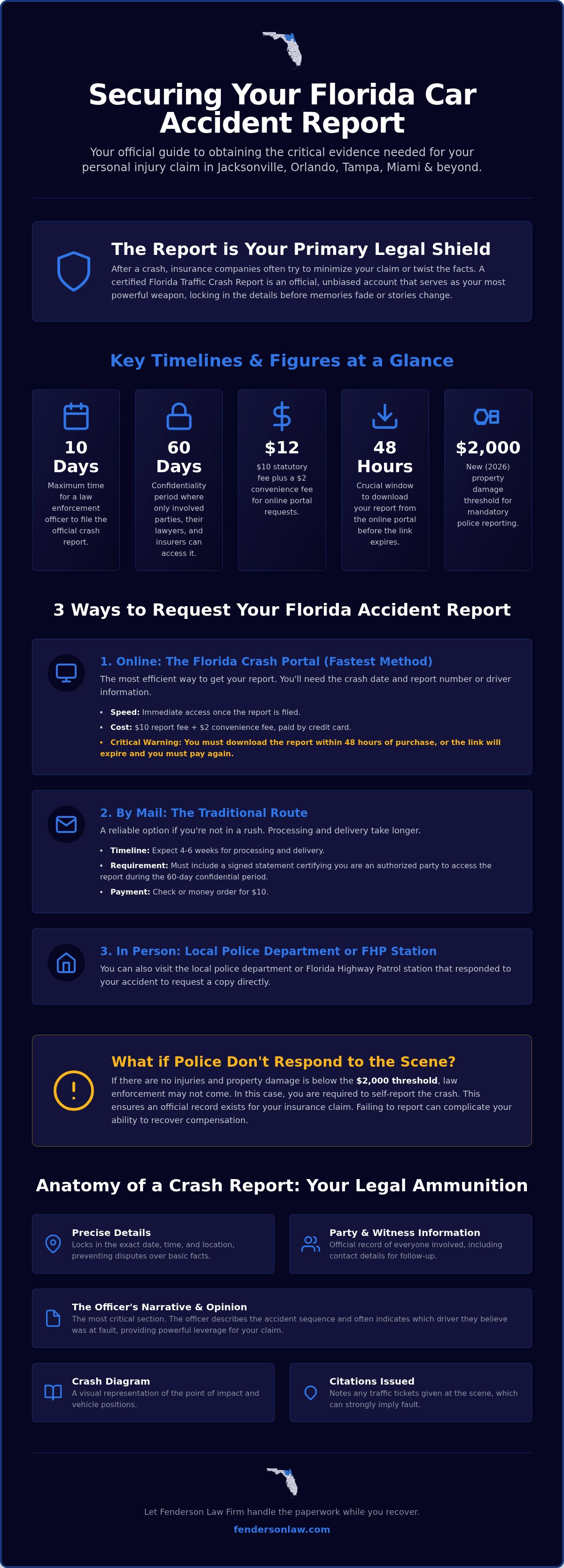
Why can't you get the report the moment the sirens stop? Florida law provides officers up to 10 days to file a formal crash report. This "10-Day Rule" exists because investigators often need time to interview witnesses, examine vehicle damage, or perform a Traffic collision reconstruction to determine exactly what happened. Under Florida Statute 321.23, the cost for these reports is set at $10. If you purchase it through the online portal, expect a $2 convenience fee. While you wait, remember that Florida Statute 316.066 keeps these reports confidential for the first 60 days. During this window, only involved parties, their legal representatives, and insurance companies can legally access the document.
The Role of the FLHSMV
The Florida Department of Highway Safety and Motor Vehicles is the official repository for all Florida crash records. Whether your accident happened on a busy Miami highway or a quiet suburb in Tampa, the FLHSMV acts as the ultimate custodian of the data. Officers typically file a "Long Form" report for accidents involving injuries, fatalities, DUIs, or vehicles that require towing. For minor property damage, a "Short Form" may be used. Regardless of the format, this state-managed record is the primary evidence used to verify your claim. Don't let the bureaucracy intimidate you; the FLHSMV provides the trail, and we help you follow it.
Why the Police Report is Your Legal Foundation
The report does more than just list names. It locks in the date, the exact time, and the precise location of the crash before memories start to fade or stories change. The most critical element is the "Officer’s Narrative," where the responding deputy or trooper describes how the accident occurred. This narrative often points toward the at-fault driver, providing the leverage your car accident lawyer jacksonville fl needs to demand a fair settlement. When an insurance company tries to twist the facts, this report stands as an objective wall. It is the tactical foundation of your fight for justice across the state of Florida.
Three Ways to Request Your Florida Accident Report in 2026
Securing your crash report is a mission-critical step in protecting your future. You don't have time to waste when insurance companies are already looking for ways to minimize your recovery. Knowing how to get a police report for a car accident in Florida allows you to seize control of the narrative. You have three primary avenues to obtain this document: digital download, traditional mail, or visiting a local precinct in person. Each method has specific requirements that you must follow to ensure your legal shield is firmly in place.
Online: The Fast Track via the Florida Crash Portal
The Florida Crash Portal is the fastest method for victims who need evidence immediately. Once you navigate to the official site, you'll enter the crash date and the report number or driver information. Be prepared to pay the $10 statutory fee plus a $2 convenience fee via credit card. There is a critical trap to avoid: you must download your report within 48 hours of purchase. If you miss this window, the link expires and you'll be forced to pay again. This digital copy is a certified record, providing the same legal weight as a paper version.
For those who aren't in a rush, mail-in requests remain an option. This process typically takes 4 to 6 weeks for processing and delivery. You must include a signed statement certifying that you're an authorized party under Florida law. This extra step prevents unauthorized entities from accessing your private data during the initial 60-day confidentiality period. Send your request along with a check or money order to the FLHSMV headquarters in Tallahassee.
Local Agency Pickup: Jacksonville, Orlando, and Tampa
Sometimes, a face-to-face interaction is the most reliable way to ensure you have exactly what you need. In Jacksonville, you can visit the JSO headquarters on East Forsyth Street to request records directly. Orlando residents should head to the OPD records window at the Orange Avenue station. If your accident occurred in Tampa, the TPD records division on Franklin Street is your destination. Each agency has its own specific hours of operation and may require a valid photo ID before releasing the document. Visiting in person can sometimes bypass the online convenience fee, though the $10 report fee still applies.
Handling these technicalities while recovering from injuries is a heavy burden. If the paperwork feels like a second accident, let a warrior for your rights take the lead. We manage the bureaucratic hurdles so you can focus on your physical recovery and getting your life back on track.
What if the Police Didn’t Come? Self-Reporting and Complications
What happens when the sirens never arrive? In high-traffic metropolitan areas like Orlando or Tampa, law enforcement may not respond to minor fender benders if there are no apparent injuries. This leaves you in a vulnerable position. If the police don't show up, the responsibility to document the event falls entirely on your shoulders. Knowing how to get a police report for a car accident in Florida becomes a proactive mission rather than a reactive task. Under updated 2026 regulations, you're legally required to self-report any crash involving injuries or property damage that appears to exceed $2,000.
If the other driver is uncooperative or refuses to wait for authorities, do not engage in a confrontation. Your priority is your safety and the integrity of your future claim. Record their license plate number, take photos of their vehicle, and gather witness statements immediately. You can file a "Driver Report of Traffic Crash" through the official state website or by mail. This self-filed document serves as your initial shield, preventing the other party from changing their story later when insurance adjusters get involved.
The Self-Reporting Checklist
You must act within 10 days to file a self-report if an officer didn't create one at the scene. Use this checklist to ensure your record is bulletproof:
- Full names and contact details of all drivers and passengers.
- Insurance policy numbers and carrier names.
- Vehicle Identification Numbers (VIN) for all cars involved.
- Statements and phone numbers from any eyewitnesses.
Failing to report a significant accident isn't just a paperwork error; it can lead to legal penalties and the immediate denial of your insurance claim. Take clear photos of the damage, the street signs, and the weather conditions to supplement your written report. This evidence is vital for victims in Jacksonville and Miami who need to prove the facts of the case without a police officer's testimony.
Confidentiality and Florida Statute 316.066
Your privacy is a priority under Florida Statute 316.066. This law dictates that crash reports are confidential and exempt from public disclosure for the first 60 days after an incident. This protection is designed to shield you from aggressive third parties who harvest data to harass victims. During this period, only "exempt parties" like you, your insurance company, and your legal counsel can access the data through the Florida Crash Portal.
Unlawful disclosure of this confidential information is a third-degree felony in Florida. We act as your authorized representative to navigate these privacy hurdles, ensuring we secure the necessary evidence while keeping your personal information out of the wrong hands. Whether you're in Jacksonville or the surrounding suburbs, our firm stands as the barrier between your private recovery and public exploitation. We handle the bureaucracy so you can focus on healing.
Why the Police Report is Your Most Powerful Weapon in a Claim
The police report isn't just a record; it's a strategic asset. Insurance adjusters treat the "Officer's Narrative" as gospel when it helps them deny a claim. They look for any mention of your speed, lane position, or reaction time to shift the blame. Knowing how to get a police report for a car accident in Florida is only the beginning. You must understand how to weaponize that data to secure the medical coverage and lost wages you deserve. This document acts as a shield, preventing the opposing side from rewriting history to suit their financial interests.
An officer's opinion on fault is influential, but it isn't the final legal authority. Florida is a comparative negligence state. This means even if a report suggests you share some blame, you can still recover damages. We aggressively challenge reports that fail to account for the full context of the crash. Our firm acts as a protector, ensuring that the official record doesn't become a barrier to your justice.
Leveraging the Report Against Insurance Companies
Florida crash reports contain "Contributing Cause" codes that act as shorthand for liability. One wrong digit can cost you thousands. We scrutinize these codes to ensure they accurately reflect the other driver's negligence. Whether the cause was distracted driving in Miami or a failure to yield in Tampa, we use this data to pin down accountability. In the most severe circumstances, such as a fatal collision, an orlando wrongful death lawyer will use the report to launch a comprehensive forensic audit of the scene.
When the Report is Wrong: Supplemental Statements
Did the officer miss a key witness in Jacksonville? Was the weather description inaccurate in Orlando? Don't panic if the initial report contains factual errors. You have the right to submit a supplemental statement to the reporting agency. We advise our clients never to engage in a heated debate with law enforcement at the scene. It's much more effective to let your legal team handle the corrections through official channels. If you've already figured out how to get a police report for a car accident in Florida but found it's riddled with mistakes, we can help you file a formal correction.
We often pair the police report with findings from our own independent investigators. This dual-layered approach ensures that a single officer's mistake doesn't dictate your future. If the official record is working against you, let our seasoned warriors fight to set it right.
Let Fenderson Law Firm Handle the Paperwork While You Recover
The burden of a crash doesn't end when you leave the scene. It's just the beginning of a fight against powerful insurance entities that want to devalue your experience. You shouldn't spend your recovery days wondering how to get a police report for a car accident in Florida or struggling with the technicalities of the state's crash portal. We act as your Determined Protector, stepping into the line of fire to handle the bureaucracy, the phone calls, and the paperwork. Our firm was established in 2010 to serve as a shield for victims, ensuring that a legal crisis doesn't shatter your future.
Your Local Shield in Jacksonville, Orlando, and Tampa
Our reach is as wide as the Florida coastline. We provide tireless representation in Jacksonville, Orlando, Tampa, Miami, and every suburb in between. From the busy intersections of Duval County to the highways of Orange and Hillsborough, our presence is felt across the state. While you focus on physical therapy, we manage the specifics of how to get a police report for a car accident in Florida and use it to build your claim. Distance is never a barrier to the justice you deserve; we represent clients across the entire geographic span of the state. It's time to stop worrying and start winning. Schedule your free consultation now to put a seasoned warrior in your corner.
Aggressive Advocacy for Accident Victims
Insurance companies and massive trucking firms have teams of lawyers working to protect their profits. You need a formidable ally who isn't afraid of conflict. We specialize in car, truck, and motorcycle accident representation, bringing a warrior's intensity to every negotiation and courtroom battle. Our goal is simple: maximize your recovery for medical bills, lost wages, and pain and suffering. We don't just fill out forms; we build a case that demands respect. We protect your liberty and your recovery with a persistence that big corporations cannot match, acting as a high-stakes ally in your struggle against these massive entities.
Accessibility is the cornerstone of our practice. This is why we offer the Fenderson Guarantee: you pay nothing unless we win your case. This financial commitment ensures that every victim has access to high-stakes legal support regardless of their current financial situation. We've served a high volume of people since 2010, proving our capability through consistent results and a commitment to long-term guardianship. Our work doesn't end with a settlement; we aim to alleviate the fear and uncertainty that follow a legal crisis. Don't let the insurance companies dictate the terms of your recovery. Contact Fenderson Law Firm for your free consultation today!
Take Command of Your Legal Shield
Are you ready to stop the insurance company from controlling your narrative? Securing your crash report is the first step in building an unbreakable legal foundation. You now understand the critical 10-day filing window and how to navigate the 2026 property damage reporting threshold. Whether you're recovering in Miami or Jacksonville, mastering how to get a police report for a car accident in Florida ensures you aren't left vulnerable to lowball settlements or deceptive insurance tactics. This document is your primary weapon for securing the justice you deserve.
Since 2010, Fenderson Law Firm has provided aggressive advocacy for victims across Orlando and Tampa. We act as a tireless protector for our clients, handling the technical bureaucracy so you can focus entirely on your physical recovery. With our no-fee-unless-you-win financial guarantee, you get elite statewide Florida coverage without any upfront costs. Don't let a single document stand between you and a fair outcome. Get Your Free Case Evaluation with Fenderson Law Firm today. Your future is worth the fight, and we're ready to stand as your shield.
Frequently Asked Questions
How long does it take for a police report to be ready in Florida?
Law enforcement agencies have a statutory deadline of 10 days to file a crash report after the incident. While you might feel an urgent need for evidence immediately after a collision in Orlando or Tampa, the system requires this processing window for accuracy. You can typically find your report on the Florida Crash Portal within this 10-day timeframe. If it's still missing after two weeks, contact the responding agency directly to ensure no clerical errors occurred.
Can I get a Florida police report for free?
No, the price for a certified crash report is statutorily set at $10 under Florida Statute 321.23. If you choose the convenience of a digital download through the state's online portal, you'll pay an additional $2.00 convenience fee per transaction. While there's no way to bypass the $10 fee for an official police report, you can self-report minor property damage using the Driver Report of Traffic Crash form at no cost to fulfill your legal obligations.
What information do I need to look up my accident report online?
To secure your document through the Florida Crash Portal, you'll need the exact date of the crash and at least one of three specific identifiers. You can search using the nine-digit crash report number provided by the officer at the scene, the driver’s license number of an involved party, or the vehicle identification number (VIN). Providing accurate details ensures you don't waste time or money on the wrong record while building your legal shield.
Is a police report required for every car accident in Florida?
Law enforcement must file a report for crashes involving injuries, fatalities, DUIs, or hit-and-run incidents. Effective October 1, 2026, the threshold for mandatory reporting of property damage increases to $2,000. If your accident falls below this amount and no one is hurt, you're still required to self-report the event within 10 days. Learning how to get a police report for a car accident in Florida is vital whenever significant damage or physical pain is involved.
What happens if the police report says I am at fault?
An officer's opinion on fault is influential but it isn't the final legal authority in your personal injury claim. Florida operates under comparative negligence laws, meaning you can still recover compensation even if you're partially responsible. We act as a determined protector for our clients, using independent investigators to challenge flawed narratives or incorrect contributing cause codes. Don't let a single document stop you from pursuing the justice and recovery you deserve after a crash.
How do I get a police report from the Jacksonville Sheriff’s Office?
You can obtain your Jacksonville Sheriff’s Office (JSO) report by visiting their records division at the Forsyth Street headquarters in person. This is often the fastest way for local residents to verify information. Alternatively, JSO reports are uploaded to the statewide Florida Crash Portal for digital download. If you're struggling with the local bureaucracy in Duval County, our firm can handle the acquisition process for you while you focus on healing from your injuries.
Can an insurance company get my police report without my permission?
Yes, insurance companies are legally classified as exempt parties under Florida Statute 316.066. This status allows them to bypass the 60-day confidentiality period that normally shields your personal data from the public. They don't need your consent to download the report and begin their investigation. Because adjusters will immediately analyze the officer’s narrative to find reasons to deny your claim, it’s essential to have your own legal warrior reviewing that same evidence.
What is the difference between a driver exchange of information and a police report?
A driver exchange is a simple document containing names, insurance details, and contact info shared at the scene. It doesn't determine fault or provide a narrative. In contrast, knowing how to get a police report for a car accident in Florida provides you with the official state record. This report includes the officer’s analysis, witness statements, and contributing cause codes. The police report is the tactical foundation needed for any successful truck or motorcycle accident claim.


