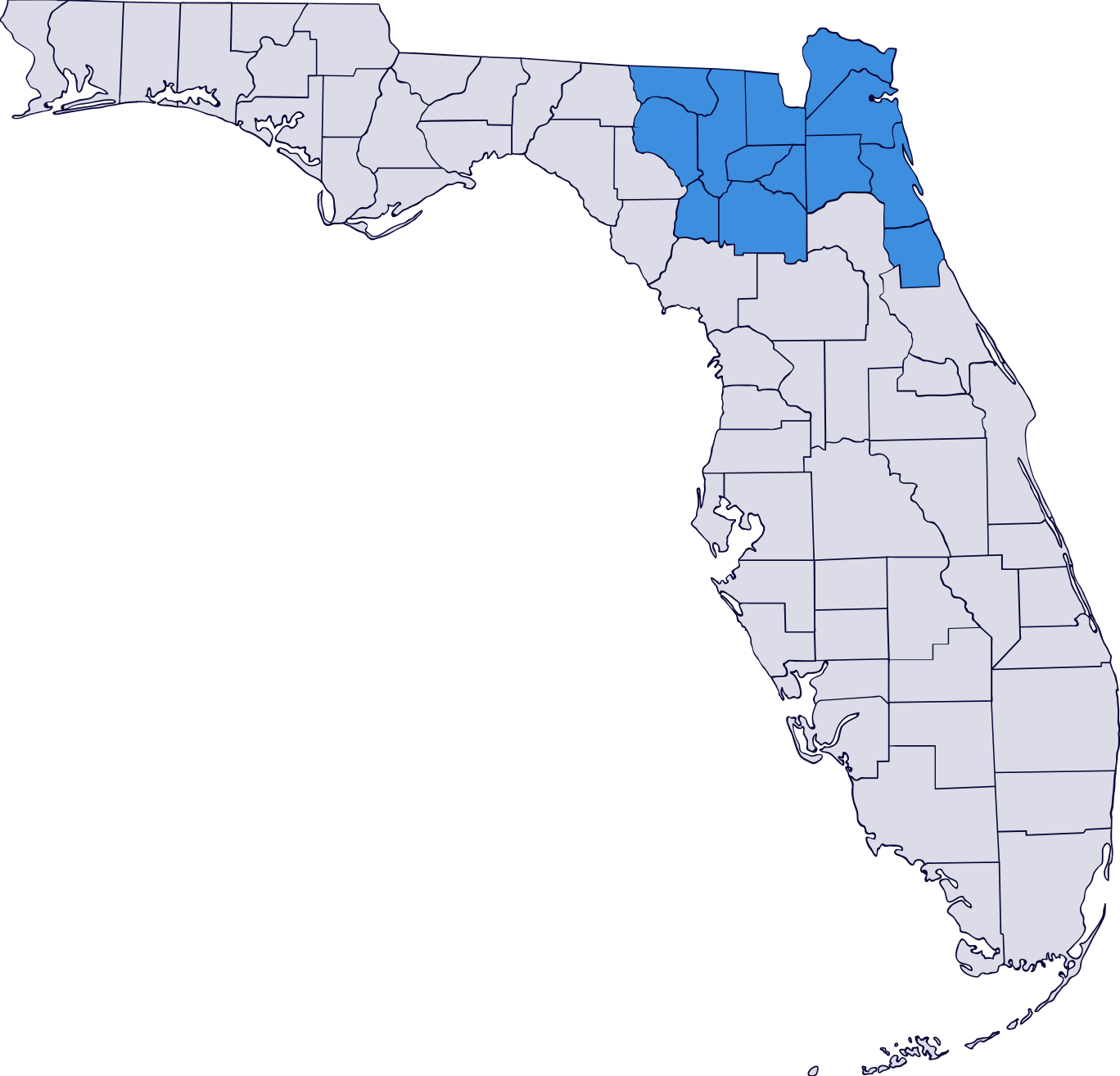
One moment you're walking through a grocery store in Tampa or a parking lot in Jacksonville, and the next you're on the ground, staring up at a ceiling, wondering how everything just changed so fast. If that moment sounds familiar, you already know the fear that follows: the mounting hospital bills, the insurance adjuster's calls, and the quiet, unsettling worry that somehow this will all be pinned on you. You're not wrong to be worried. Florida's premises liability laws are genuinely complex, and without the right Florida slip and fall lawyer standing between you and a well-resourced property owner, that fear can become your reality.
Here's what most people don't realize: a slip and fall in Florida isn't just an accident you recover from. It's a legal battle fought against insurance companies and corporate defense teams who are already building their case against you. They have time, resources, and experience on their side. You deserve the same.
This guide will show you exactly how to fight back, protect your rights across every major Florida city and suburb, and secure the full compensation you're owed, from your emergency room bills today to your long-term care tomorrow.
Key Takeaways
- Florida's modified comparative negligence law means that if you are found more than 50% at fault for your fall, you lose your right to recover any compensation — a rule insurance companies aggressively exploit against victims in cities like Orlando, Tampa, and Jacksonville.
- Working with an experienced Florida slip and fall lawyer is critical because property owners owe different legal duties depending on who you are, and proving that duty was breached requires specific evidence gathered quickly before it disappears.
- Your claim's true value extends far beyond your initial hospital bills — it can include lost wages, future medical care, and non-economic damages like pain, suffering, and lost enjoyment of life that insurers routinely undervalue.
- Local hazards vary significantly across Florida's major metros, from theme park and resort properties in the Orlando suburbs to sprawling retail centers in Jacksonville, and a lawyer with regional knowledge can anticipate the defense strategies unique to each venue type.
- Fenderson Law operates on a no recovery, no fee basis, meaning you can pursue full and fair compensation across any major Florida market — from Miami to Tampa — without any upfront financial risk.
What is a Florida Slip and Fall Case? Understanding Premises Liability
A Florida slip and fall case is a legal claim built on a straightforward but powerful principle: when a property owner's negligence creates a dangerous condition and you get hurt because of it, that owner is financially responsible for your injuries. This falls under the broader legal framework known as premises liability, and it covers far more than a simple "accident." It's a recognition that preventable harm has real consequences; to better understand these standards, you can explore Premises Liability through the resources provided by The Todd Law Group, PLLC.
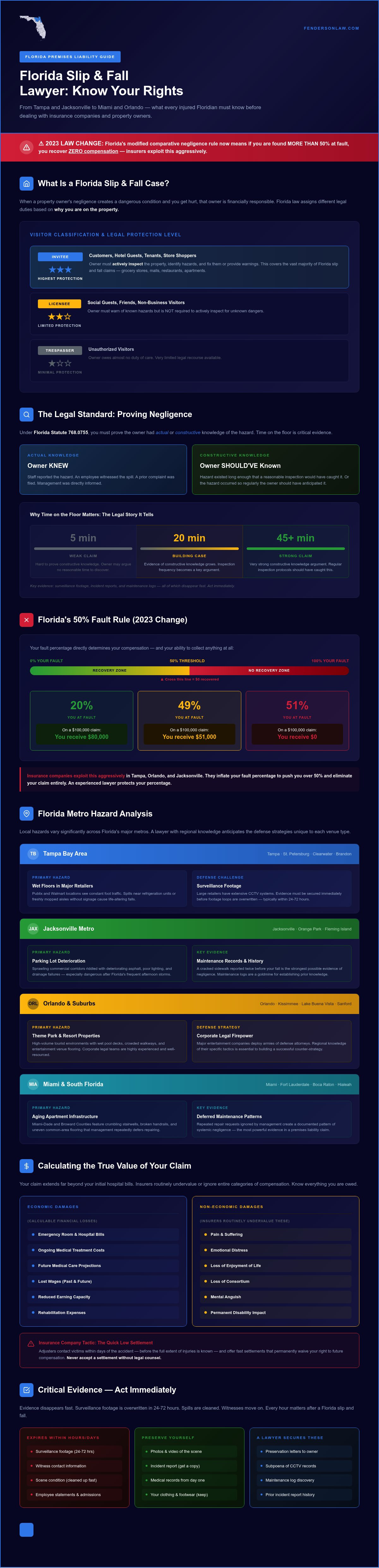
Florida law doesn't treat all visitors the same way. The legal duty a property owner owes you depends heavily on why you're on their property. Invitees, meaning customers in a store, guests at a hotel, or tenants in an apartment complex, receive the highest level of protection. Owners must actively inspect their property, identify hazards, and either fix them or warn visitors. Licensees, such as social guests, receive a more limited duty. Trespassers receive almost none. Understanding which category you fall into is the first critical step any experienced florida slip and fall lawyer will take when evaluating your claim.
Here's what insurance companies don't want you to understand: most falls aren't random accidents. They're the predictable result of systemic maintenance failures. A spill that sits for 45 minutes. A cracked sidewalk that's been reported twice. A parking lot light that's been burned out for weeks. These aren't isolated oversights; they're patterns of negligence that a skilled legal team can expose.
Common Slip and Fall Scenarios in Florida
Florida's unique mix of high-traffic retail environments, aging apartment infrastructure, and sprawling commercial developments creates specific, recurring hazard patterns across the state:
- Wet floors in major retailers: Publix and Walmart locations throughout Tampa, Orlando, and South Florida see constant foot traffic. A spill near a refrigeration unit or a freshly mopped aisle without proper signage can become a life-altering fall in seconds.
- Poorly maintained walkways in Miami apartment complexes: Older multifamily properties in Miami-Dade and Broward Counties frequently feature crumbling stairwells, broken handrails, and uneven common-area flooring that management defers repairing indefinitely.
- Uneven pavement and debris in Jacksonville parking lots: Jacksonville's sprawling commercial corridors are riddled with deteriorating asphalt, poor lighting, and drainage failures that create dangerous conditions, particularly after Florida's frequent afternoon storms.
The Legal Standard for Negligence
Proving negligence requires more than showing you fell. You must demonstrate that the property owner either knew about the hazard or should have known about it through reasonable inspection. This is the distinction between "actual knowledge" and "constructive knowledge." Under Florida Statute 768.0755, constructive knowledge can be established by proving the dangerous condition existed long enough that the owner should have discovered it through ordinary care, or that the condition occurred with enough regularity that the owner should have anticipated it.
Time matters enormously here. A spill that's been on a floor for five minutes tells a very different legal story than one that's been there for an hour. Evidence like surveillance footage, incident reports, and maintenance logs can establish exactly how long a hazard existed, and that evidence disappears fast. At Fenderson Law, we move quickly to preserve it, acting as your shield before the property owner's legal team has a chance to bury it.
The 50% Rule: Proving Fault Under Florida's New Negligence Laws
Florida changed the rules in 2023. What used to be a system that allowed injured victims to recover at least partial compensation — even if they were mostly at fault — is now a legal minefield where crossing a single threshold destroys your entire case. Understanding exactly what changed, and why it matters to your claim, is no longer optional. It's survival.
The Impact of the 2023 Tort Reform
Florida's legislature replaced the state's longstanding pure comparative negligence standard with a modified comparative negligence system. Under the old framework, even a plaintiff found 90% at fault could recover 10% of their damages. Under the current law, if you are found to be more than 50% responsible for your own fall, you recover nothing. Zero. The moment a jury or adjuster assigns you 51% of the blame, your medical bills, your lost wages, and your pain become entirely your own financial burden to carry.
Insurance companies didn't just notice this change. They weaponized it. Their adjusters are now trained to build fault narratives around you from the moment a claim is filed. Were you looking at your phone? Were you wearing inappropriate footwear? Did you walk past a warning sign? Every detail of your behavior becomes ammunition in a strategy designed to push your fault percentage past that 50% threshold and eliminate your recovery entirely.
This is precisely where aggressive legal advocacy stops being a luxury and starts being a necessity. At Fenderson Law, countering "blame the victim" tactics begins before the first demand letter is ever sent. The firm's approach is to build a proactive fault narrative on your behalf, one that anchors the negligence firmly on the property owner's documented failures rather than allowing the defense to define the story first.
One of the most commonly exploited defenses is the "open and obvious" doctrine. Defense teams in Tampa, Orlando, Jacksonville, and Miami regularly argue that a hazard was so visible that any reasonable person would have avoided it, effectively transferring blame to the victim. Dismantling this argument requires more than saying the hazard wasn't obvious. It requires evidence, expert testimony, and a legal team that understands how Florida courts have applied this doctrine in commercial and residential property contexts across the state's major metros.
Collecting Evidence to Counter Comparative Fault
Keeping your fault percentage low isn't a passive process. It demands an immediate, coordinated evidence-collection effort that begins within hours of your fall, not days. Three categories of evidence are consistently decisive:
- Surveillance footage: Retail locations throughout South Florida, Central Florida, and the Jacksonville corridor maintain security camera systems that automatically overwrite footage on cycles as short as 48 to 72 hours. An immediate legal hold and subpoena is the only reliable way to preserve this evidence before it's gone. Footage that shows a hazard existing long before your fall, or that contradicts a manager's incident report, can be the single most powerful asset in your case.
- Witness statements: Bystanders who saw your fall are most accurate and most willing to cooperate in the immediate aftermath. Waiting weeks to contact them risks memory degradation, changed contact information, and, in some cases, pressure from the property owner's legal team. Locking in sworn statements early protects the integrity of their testimony.
- Maintenance logs and inspection records: These documents reveal whether a property owner in a Broward County apartment complex or an Orlando shopping center had prior knowledge of a recurring hazard and chose to defer repairs. A pattern of neglect documented in the owner's own records is extraordinarily difficult to explain away in front of a jury.
If you've been injured on someone else's property anywhere in Florida, the evidence that proves their negligence is already disappearing. An experienced Florida slip and fall lawyer moves to preserve it before the defense team has a chance to let it vanish.
From Orlando Theme Parks to Tampa Bay Retail: Local Hazard Analysis
Florida isn't one market. It's a collection of distinct environments, each with its own infrastructure patterns, property ownership structures, and recurring hazard profiles. A slip and fall at a Disney-adjacent resort property in Kissimmee is a fundamentally different legal challenge than a fall in a Jacksonville strip mall parking lot or a Miami high-rise parking garage. The defense strategies differ. The corporate legal teams differ. And the evidence that wins each case differs. Regional knowledge isn't a bonus. It's the difference between a settlement that covers your future and one that barely covers last month's bills.
In the Orlando suburbs, Kissimmee, Lake Buena Vista, and the International Drive corridor, slip and fall claims frequently arise on resort and theme park adjacent properties: hotel pool decks with inadequate drainage, convention center walkways with uneven tile transitions, and shuttle loading zones where water pools after Florida's afternoon storms. The property owners in this corridor are often massive corporate hospitality entities with dedicated risk management departments and legal teams whose sole job is to minimize payouts. They move fast. Your florida slip and fall lawyer needs to move faster.
In Miami and Tampa, high-rise residential towers and multi-level parking garages create a specific, underreported category of hazard. Poorly lit parking structures in Brickell and Midtown Miami, crumbling concrete ramps in Ybor City, and elevator lobbies with worn, slippery flooring in waterfront condo towers are consistent sources of serious injuries. Building owners often deflect responsibility onto property management companies, who in turn point to maintenance contractors. Untangling that liability chain requires someone who knows exactly how Florida courts assign responsibility across multi-party commercial real estate arrangements.
Retail and Grocery Store Negligence
Big-box retailers and grocery chains operating across Jacksonville, Gainesville, Pensacola, and the Tampa Bay suburbs have sophisticated incident response protocols designed to protect them, not you. The moment a fall is reported, their team begins documenting the scene in ways that favor their defense. Suing a national retailer in Florida means confronting attorneys who handle hundreds of these claims annually. Local strip malls present a different challenge: smaller operators often carry minimal insurance, making early asset investigation critical. If you've been hurt in a retail environment anywhere in Florida, understanding how aggressive advocacy works against powerful entities is the first step toward leveling that playing field.
Public vs. Private Property Claims
Falls on government-owned property, a cracked Tallahassee sidewalk, a flooded Broward County courthouse entrance, or a deteriorating Hillsborough County park pathway, carry strict procedural requirements that can permanently bar your claim if missed. Florida's sovereign immunity framework requires a formal notice of claim filed within three years of the incident for most government entities, with specific formatting rules that differ from standard civil litigation. Private landlord claims in residential settings operate under an entirely different framework, where habitability standards and lease terms introduce additional legal complexity. Knowing which rules apply, and applying them precisely, is non-negotiable.
The geography of your fall shapes every element of your case. A florida slip and fall lawyer with genuine regional depth across Central Florida, South Florida, Northeast Florida, and the Gulf Coast doesn't just understand the law. They understand the local players, the local courts, and the local tactics that property owners use to escape accountability in each specific market.
Calculating the Real Value of Your Slip and Fall Claim
Most injured Floridians walk away from a settlement accepting far less than they're owed. Not because the law failed them, but because they didn't know what they were entitled to claim in the first place. Insurance adjusters in Tampa, Orlando, Jacksonville, and Miami are counting on exactly that gap in your knowledge. Closing it starts here.
Your claim has three distinct financial layers, and every one of them matters.
Economic damages are the measurable, documentable losses: emergency room charges, surgical costs, ambulance fees, prescription medications, follow-up specialist appointments, and every dollar of income you couldn't earn while you were recovering. For a warehouse worker in Jacksonville or a hospitality employee in Kissimmee who depends on physical labor, even a six-week recovery can translate into tens of thousands in lost wages. These numbers are calculable, and they should be calculated precisely, not approximated.
Non-economic damages are where insurers consistently lowball victims. Pain and suffering, emotional distress, loss of consortium, and diminished enjoyment of life are real injuries with real dollar values, but they require skilled legal framing to quantify. A retired couple in Boca Raton who can no longer walk the beach together because of a hip fracture from a negligent property owner has suffered a loss that no medical bill can fully capture. An experienced florida slip and fall lawyer knows how to translate that human reality into a number a jury will respect.
Future care costs are the most commonly overlooked category. A serious fall can require months of physical therapy, orthopedic follow-ups, or even permanent assistive devices. If your injuries aren't fully resolved at settlement, you cannot go back and renegotiate. Every dollar of anticipated future treatment must be accounted for before you sign anything.
Medical Evidence and Expert Testimony
Seeing a doctor immediately after your fall isn't just about your health. It's the single most powerful action you can take to protect your claim's value. Gaps in treatment give insurance adjusters in South Florida and Central Florida the opening they need to argue your injuries weren't serious, or weren't caused by the fall at all. Diagnostic imaging, particularly MRIs, can reveal soft tissue damage, disc herniations, and nerve injuries that X-rays miss entirely, injuries that are very real and very expensive to treat but invisible without the right testing. Maximum Medical Improvement, or MMI, is the point at which your treating physician determines your condition has stabilized; settling before you reach MMI means accepting compensation before anyone knows the full scope of what your recovery will cost.
Factors That Increase Settlement Amounts
Not every slip and fall claim carries the same weight. Several factors can significantly increase what you're owed:
- Permanent impairment or scarring: A fall that leaves a Broward County resident with a permanent limp or visible facial scarring carries substantially higher non-economic damages than a fully resolved soft tissue injury.
- Gross negligence: When evidence shows a property owner had repeated written warnings about a hazard and ignored them, juries respond to that documented indifference. It shifts the case from ordinary negligence into a category that demands a larger reckoning.
- Multiple liable parties: As outlined in the previous section, complex ownership structures across Miami high-rises and Jacksonville commercial corridors can mean multiple defendants, each carrying their own insurance policy. Understanding how aggressive personal injury advocacy works against powerful entities is critical when navigating those multi-party claims.
Fenderson Law operates on a no recovery, no fee basis. You pay nothing unless the firm secures your compensation. For a family in Gainesville managing medical debt, or a single parent in Pensacola who can't afford to gamble on legal fees, that guarantee removes the financial barrier standing between you and the full fight you deserve. Contact a Florida slip and fall lawyer at Fenderson Law before the evidence disappears and the insurance company's version of events becomes the only one on record.
Why Choose Fenderson Law as Your Florida Slip and Fall Advocate?
There's a difference between a law firm that handles your case and one that fights for your future. At Fenderson Law, your recovery isn't a file on a desk. It's a mission. From the moment you make contact, the firm's approach is built around a single objective: securing every dollar you're owed from the property owner whose negligence changed your life.
That determination isn't abstract. It shows up in how quickly the firm moves to preserve disappearing evidence in Jacksonville retail corridors. It shows up in how aggressively it challenges the fault narratives that insurance adjusters build against injured residents in Tampa and Orlando. It shows up when a Miami apartment complex tries to deflect liability across three different contractors, and Fenderson Law untangles that chain and holds every responsible party accountable.
You won't be passed off to a paralegal and forgotten. Direct communication is a core commitment here. You'll know what's happening with your case, why specific legal decisions are being made, and what the realistic path forward looks like. That transparency isn't common in large personal injury practices. At Fenderson Law, it's standard.
Powerful insurers don't intimidate this firm. Corporate defense teams with dedicated slip and fall units don't either. The warrior mindset that defines Fenderson Law's advocacy was built specifically for these confrontations, and it operates with equal intensity whether your fall happened in a Pensacola strip mall, a Gainesville apartment complex, a Kissimmee resort corridor, a Boca Raton parking garage, or a Broward County grocery store. Regional reach isn't a marketing claim. It's the operational reality of a firm that serves Jacksonville, Orlando, Tampa, Miami, and every major Florida market in between.
Our Performance-Based Promise
Fenderson Law takes on your case on a no recovery, no fee basis. You pay nothing upfront. The firm absorbs the financial risk so that a family in Ybor City managing medical debt, or a worker in Gainesville who can't afford to gamble on legal costs, can still access the full force of aggressive legal advocacy. A free case evaluation is the starting point, giving you a professional assessment of your claim with zero financial obligation attached.
Take the First Step Toward Justice
Waiting is the single most dangerous thing you can do after a slip and fall in Florida. Evidence vanishes within days. Witness memories fade. And Florida's statute of limitations creates a hard legal deadline that, once missed, permanently forecloses your right to recover anything. The insurance company's team is already working. Your florida slip and fall lawyer needs to be working too.
Don't let the property owner's version of events become the only version on record. Schedule Your Free Case Review with Fenderson Law Now and put a determined protector between you and the people who are already building a case against you.
Your Next Step Toward Full Recovery Starts Now
A slip and fall in Florida isn't just a bad day. It's a legal battle that begins the moment you hit the ground, and the property owner's defense team is already moving. This article has walked you through the critical stakes: Florida's modified comparative negligence threshold, the disappearing evidence that defines your claim's strength, the regional hazard patterns from Jacksonville to Miami, and the full financial picture that insurers routinely hide from you.
Here's what ties it all together: the outcome of your case depends almost entirely on how fast you act and who's fighting beside you. An experienced florida slip and fall lawyer from Fenderson Law, a firm built on aggressive advocacy since 2010, puts a determined protector between you and the powerful entities working against your recovery.
There's no financial risk to starting. Fenderson Law's no win, no fee guarantee means you pay nothing unless compensation is secured. Whether your fall happened in Orlando, Tampa, Pensacola, or Boca Raton, you deserve a full and fair fight.
Contact Fenderson Law for a Free Slip and Fall Case Evaluation today. Your recovery is worth protecting.
Frequently Asked Questions About Florida Slip and Fall Claims
How long do I have to file a slip and fall lawsuit in Florida?
Florida gives you two years from the date of your fall to file a personal injury lawsuit, following the 2023 tort reform that shortened the previous four-year window. Missing this deadline permanently forecloses your right to any compensation, regardless of how strong your case is. If your fall happened on government property in Tallahassee, Broward County, or anywhere else in Florida, a separate notice of claim requirement applies with its own strict timeline.
Don't treat this deadline as a reason to wait. Evidence disappears within days, not years. Acting immediately gives your legal team the best possible foundation to build your case before critical surveillance footage is overwritten and witnesses become unreachable.
What if I was partially at fault for my slip and fall accident?
You can still recover compensation as long as you're found 50% or less at fault under Florida's modified comparative negligence law. If you're assigned 30% of the blame, you recover 70% of your total damages. However, once your fault exceeds 50%, you recover nothing at all, which is precisely why insurance adjusters in Orlando, Tampa, and Jacksonville aggressively try to inflate your share of responsibility.
A skilled Florida slip and fall lawyer builds a counter-narrative immediately, anchoring fault on the property owner's documented failures before the defense team frames the story first. Surveillance footage, maintenance logs, and witness statements are the tools that keep your fault percentage where it belongs.
How much does a Florida slip and fall lawyer cost?
Fenderson Law handles slip and fall cases on a no recovery, no fee basis, meaning you pay nothing upfront and owe nothing unless compensation is secured. This removes the financial barrier that stops many injured residents in Gainesville, Pensacola, or Boca Raton from pursuing the full fight they deserve. You should verify specific contingency fee percentages directly with the firm during your free case evaluation.
What should I do immediately after falling in a store or restaurant?
Report the fall to a manager before you leave the premises and request a written incident report. Photograph the hazard, your injuries, your footwear, and the surrounding area from multiple angles. Collect names and contact information from anyone who witnessed the fall. Don't minimize your pain to staff or sign anything before speaking with an attorney.
Seek medical attention the same day, even if you feel fine. Adrenaline masks pain, and injuries like disc herniations or soft tissue damage often surface hours or days later. A gap between your fall and your first medical visit gives insurance adjusters in South Florida and Central Florida an opening to argue your injuries weren't caused by the fall at all.
Can I sue a Florida city if I fell on a public sidewalk?
Yes, but the process is significantly more complex than a standard premises liability claim. Florida's sovereign immunity framework requires you to file a formal notice of claim against the relevant government entity before pursuing litigation. Specific formatting rules apply, and the timeline differs depending on whether the responsible party is a city, county, or state agency. A cracked sidewalk in Tallahassee and a flooded courthouse entrance in Broward County each involve different governmental defendants with their own procedural requirements.
Missing any step in this process can permanently bar your claim, even if the government's negligence is obvious. Consulting a Florida slip and fall lawyer immediately after a fall on public property isn't optional; it's the only way to protect your right to recover.
How do I prove the property owner knew about the hazard?
Florida law recognizes two types of knowledge: actual knowledge, meaning the owner was directly told about the hazard, and constructive knowledge, meaning the hazard existed long enough that a reasonable inspection would have revealed it. Maintenance logs, prior incident reports, employee complaints, and repair request records can establish that a Publix in Tampa or an apartment complex in Miami-Dade knew about a recurring problem and chose to ignore it.
Surveillance footage is particularly powerful here. Video showing a spill sitting on a floor for 45 minutes before your fall tells a very different legal story than one that shows it appeared seconds before you walked through. Preserving that footage requires immediate legal action because many Florida retailers overwrite their systems within 48 to 72 hours.
What is the average settlement for a Florida slip and fall case?
There's no reliable average because settlement values vary enormously based on injury severity, the strength of liability evidence, the property owner's insurance coverage, and whether the fall caused permanent impairment. A soft tissue injury that resolves in six weeks carries a fundamentally different value than a hip fracture requiring surgery and ongoing physical therapy for a resident in Jacksonville or Kissimmee. Quoting an average figure would give you a misleading benchmark that doesn't reflect your specific circumstances.
What matters is that your claim captures all three layers of damages: current medical costs, lost income, and future care expenses, plus non-economic damages like pain, suffering, and diminished quality of life. A free case evaluation with Fenderson Law gives you a realistic picture of what your specific claim is worth.
Do I need to see a doctor even if I don't feel hurt right away?
Yes, and this is one of the most important steps you can take to protect both your health and your claim. Injuries like herniated discs, nerve compression, and internal soft tissue damage frequently produce delayed symptoms that don't appear until 24 to 72 hours after a fall. Without an immediate medical record connecting your injuries to the incident, insurance adjusters across Florida will argue the fall wasn't the cause.
Diagnostic imaging, particularly MRIs, can reveal damage that standard X-rays miss entirely. Establishing a clear, uninterrupted treatment record from the day of your fall through your maximum medical improvement is the foundation of a fully valued claim. Don't give the defense a gap in your timeline to exploit.


