
What if the most devastating part of your accident isn't the physical trauma, but the cold, calculated way an insurance adjuster tries to erase your experience? You've likely felt the sting of being treated like a claim number rather than a human being whose life changed in an instant on I-275 or a quiet street in Carrollwood. The reality is that calculating pain and suffering in a Tampa injury claim is a high-stakes battleground where your emotional distress must be weaponized into a concrete financial figure. It’s not just about medical bills; it’s about the life you've lost and the future you're trying to protect.
You deserve a formidable shield against powerful corporations that downplay your "quality of life" loss to save their bottom line. We know the anxiety you feel regarding Florida’s modified comparative negligence laws, which now bar recovery if you're found even 51 percent at fault. This guide will teach you the exact methods elite attorneys use to turn your trauma into a fair settlement. We will break down the multiplier and per diem math, clarify why the 14-day PIP rule still matters in 2026, and provide the confidence you need to stand firm against big insurance.
Key Takeaways
- Understand the legal distinction between physical agony and emotional distress to ensure every facet of your trauma is documented in your demand.
- Master the Multiplier and Per Diem formulas used for calculating pain and suffering in a Tampa injury claim to estimate your settlement’s true potential value.
- Learn how Florida’s 51% modified comparative negligence rule can strip you of your rights and how to shield your claim from aggressive insurance adjusters.
- Discover how to use daily pain journals and expert testimony from neurologists to turn invisible suffering into undeniable evidence for Hillsborough County juries.
- Leverage a performance-based financial guarantee to secure aggressive advocacy that protects your future without any upfront legal costs.
What Qualifies as Pain and Suffering in a Tampa Injury Claim?
How do you quantify the fear that grips you every time you merge onto the Selmon Expressway? Calculating pain and suffering in a Tampa injury claim starts with understanding that Florida law recognizes more than just your medical bills. Non-economic damages represent the human toll of negligence. While economic damages cover what you've lost from your wallet, the legal concept of pain and suffering accounts for what you've lost from your life. It's the compensation for the agony you endure and the joy you can no longer experience.
Insurance adjusters in Hillsborough County often try to "zero out" these damages during initial negotiations. They treat your trauma as a line item they can simply delete. They assume that if you look okay in a deposition, you aren't suffering. We know better. We see the warrior in you struggling to get back to the life you had before the crash. Whether your accident happened in the heart of downtown or the suburbs of Brandon, your pain is real, and it has a specific legal value.
Common Examples of Non-Economic Damages
Your claim rests on two pillars: physical pain and emotional distress. In Tampa, this often includes chronic physical agony that makes a simple walk through Hyde Park Village impossible. It includes the mental anguish, PTSD, and sleep disturbances that haunt you after a violent collision. We also fight for "loss of consortium," which addresses the devastating impact your injuries have on your relationship with your spouse and children. If your injuries prevent you from boating in the Gulf or attending a Bucs game at Raymond James Stadium, you've lost a vital part of your Florida lifestyle that deserves recognition.
The 'Invisible' Injury: Why Proof Matters in Tampa
Hillsborough County courts require clear evidence to validate subjective pain. Under Florida's "tort threshold," you must often prove a permanent injury to recover these damages in an auto claim. Temporary soreness won't cut it. A jury needs to see how your life has fundamentally shifted. You need a personal injury lawyer near me who understands how to bridge the gap between your "invisible" symptoms and the legal proof required by a judge. We act as your shield, ensuring that your emotional scars are treated with the same weight as a broken bone. We don't let the insurance company ignore the parts of your recovery that don't show up on an X-ray.
The Math: Multiplier vs. Per Diem Calculation Methods
How does a cold insurance algorithm decide what your sleepless nights and physical agony are worth? It isn't magic; it's a calculated attempt to minimize your recovery. When it involves calculating pain and suffering in a Tampa injury claim, adjusters and attorneys typically rely on two distinct mathematical frameworks to translate human trauma into compensatory damages. Understanding these formulas is your first line of defense against a lowball offer that ignores the reality of your recovery.
In Florida, the multiplier method is the industry standard for arriving at a settlement figure in Tampa personal injury cases. While the per diem approach has its place, especially in trial scenarios, the multiplier method dictates the rhythm of most negotiations held in conference rooms across Hillsborough County. The method you choose can mean the difference between a check that covers your bills and one that actually secures your future.
Understanding the Multiplier Method
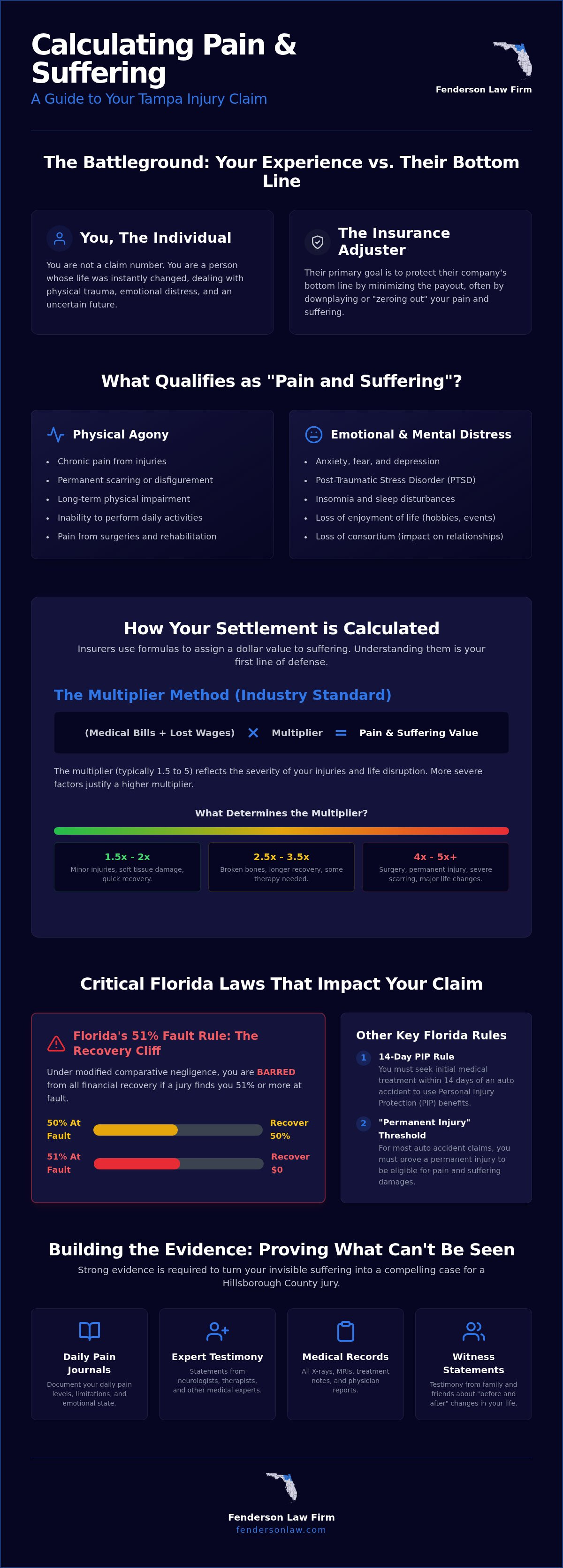
The multiplier method is the industry standard for calculating pain and suffering in Tampa settlements. This formula takes your "special damages"—the concrete economic losses like medical bills and lost wages—and multiplies them by a number between 1.5 and 5. The specific number chosen, known as the multiplier, reflects the severity of your disruption. A minor fender-bender with soft tissue bruising might sit at a 1.5, while a life-altering spinal injury from a wreck on the Howard Frankland Bridge could command a 5.0.
Adjusters look for "shock value" and "hard" evidence to justify higher multipliers. Surgery carries significantly more weight than physical therapy or chiropractic care. If your records show permanent scarring, long-term impairment, or a clear "before and after" shift in your ability to work, we push for the higher end of the scale. We don't let them treat a surgical recovery with the same weight as a few weeks of soreness.
The Per Diem (Daily Rate) Approach
The per diem method assigns a specific dollar value to every day you live in pain, starting from the date of the accident until you reach Maximum Medical Improvement (MMI). To justify this daily rate, many attorneys use your actual daily income as a benchmark. The logic is simple: if your time is worth $250 a day to your employer when you're healthy, it's worth at least that much when you're suffering through a recovery. This approach is often more effective for chronic, long-term pain that doesn't necessarily require expensive surgeries but still ruins your daily life.
However, using this method in front of a Tampa jury carries risks. If a trial lasts for years, the cumulative daily total can seem astronomical to jurors, leading them to "check out" or feel the number is unreasonable. It requires a warrior’s precision to present this math without losing the jury's empathy. If you're struggling to see which formula fits your specific trauma, consulting with the team at Fenderson Law Firm can provide the clarity you need to move forward with confidence.
Florida Law: How Local Rules Impact Your Tampa Check
The math we discussed earlier doesn't exist in a vacuum. In 2026, the legal environment for calculating pain and suffering in a Tampa injury claim is more hostile than ever. Recent shifts in Florida legislation have handed insurance companies new weapons to slash your settlement or eliminate it entirely. You need to understand these rules before you step into a negotiation room in downtown Tampa or file a claim in the 13th Judicial Circuit.
While your medical bills are fixed numbers, your pain and suffering award is highly sensitive to how much blame an adjuster can pin on you. Florida’s no-fault system still requires you to carry $10,000 in Personal Injury Protection (PIP), but that only scratches the surface of a serious injury. To recover non-economic damages from the at-fault driver, you must meet the "serious injury threshold," proving permanent damage or significant scarring. If you don't meet this bar, your pain and suffering claim may never even leave the ground.
The 51% Rule: A Shield for Insurance Companies
Florida now operates under a modified comparative negligence standard. This is a massive shift from the old "pure" comparative negligence rules. If you are found to be 51 percent or more at fault for your accident, you receive exactly zero dollars. Nothing. This 51 percent bar acts as a shield for insurance companies, who now work tirelessly to shift just enough blame onto you to kill your claim entirely.
Even if you are only 10 percent at fault for a crash near USF or on the Gandy Bridge, your final check for pain and suffering is reduced by that 10 percent. We fight these blame-shifting tactics by aggressively proving the other driver’s liability. We don't let them rewrite the facts of your accident to save themselves money. Our role is to act as your shield, ensuring that your percentage of fault is kept as low as possible to maximize your recovery.
Statute of Limitations and Filing in Tampa
Time is your greatest enemy. For negligence claims in Florida, you generally have a two-year window from the date of the incident to file a lawsuit. This was shortened from four years back in 2023, and the urgency is real. If you wait too long, you lose your right to seek justice forever. In Hillsborough County, filing fees are standardized, but the complexity of your case dictates your strategy. For instance, a florida truck accident lawyer is essential when dealing with commercial carriers that have their own teams of investigators on the scene within hours. Whether you are dealing with a standard car wreck or a complex commercial collision, the local filing nuances in Tampa require a warrior who knows the 13th Judicial Circuit inside and out.
Building the Evidence: Proving What Can’t Be Seen
If you can't see it on a scan, an insurance adjuster will try to claim it doesn't exist. This is the primary hurdle in calculating pain and suffering in a Tampa injury claim. We don't let them dismiss your reality. We build a wall of evidence that forces them to acknowledge the human cost of your accident. Proving non-economic damages requires a strategic blend of scientific data and human testimony that paints a vivid picture of your life before and after the trauma.
The "Pain Journal" is your most effective tool for documenting the invisible. Don't just list a pain level from one to ten. Describe how the injury prevented you from picking up your child in Temple Terrace or how it ruined a family dinner in Westchase. These specific, local details create a narrative that a Hillsborough County jury can actually feel. We supplement your personal account with expert witnesses, such as neurologists and psychologists, to validate the clinical reality of your suffering. Additionally, lay witnesses like neighbors in South Tampa or coworkers in Ybor City can testify to the visible changes in your personality and physical abilities.
Medical Documentation is the Foundation
Consistency in treatment is your greatest weapon. Gaps in care are the first thing an adjuster looks for to kill your pain and suffering claim. If you skip physical therapy sessions, they will argue you aren't actually in agony. We ensure every MRI, X-ray, and mental health session is linked directly to the accident. Objective findings support your subjective pain. If you've sought treatment for anxiety or depression since the crash, that documentation is vital. It proves that the trauma has moved from your body into your mind, requiring a higher multiplier for your settlement.
Social Media and Digital Warnings
Your Instagram feed is a minefield. That photo of you smiling at a Lightning game can be used to "prove" you aren't suffering, even if you were in physical agony five minutes after the shutter clicked. Tampa adjusters are trained to hunt for any digital evidence that contradicts your claim. The "Do Not Post" rule is absolute during an active injury lawsuit. In Florida, privacy settings are not a shield against legal discovery. If you're involved in a high-stakes claim, your digital life is an open book. If you want to ensure your trauma is taken seriously, contact Fenderson Law Firm to secure the aggressive advocacy you need to protect your recovery.
Why Fenderson Law is the Protector of Your Tampa Settlement
Who stands between you and an insurance giant that wants to erase your trauma? When it involves calculating pain and suffering in a Tampa injury claim, you need more than a simple calculator; you need a seasoned warrior. Fenderson Law Firm has served as an aggressive shield for the injured since 2010. We don't just look at the medical bills you've already paid. We calculate the true value of your future, including the years of physical therapy, the emotional toll on your household, and the lost moments of joy across the Tampa, Jacksonville, and Orlando communities.
Our "No Win, No Fee" promise is the cornerstone of our accessibility. It means you don't pay a single cent in legal fees unless we successfully secure a recovery for you. This financial guarantee ensures that every victim in Hillsborough County has access to elite representation, regardless of their current financial situation. We take the legal risk so you can focus entirely on your physical and emotional healing. Our commitment is to provide a steady, reassuring rhythm of support during your most stressful hours.
The Fenderson Advantage: We Don’t Back Down
We aren't a settlement factory that churns through cases to meet a quota. We're a shield for your family's future. When calculating pain and suffering in a Tampa injury claim, we look beyond the immediate trauma to see the permanent impact on your quality of life. We don't back down when the insurance company's math doesn't match the reality of your agony. If a fair settlement isn't offered, we're prepared to take your claim to trial in the Hillsborough County courts. T. Charles Fenderson provides direct access and decades of experience, ensuring your voice is heard by those who seek to silence it.
Take the First Step Toward Justice
Your path to recovery starts with a single, decisive action. During your free Tampa injury consultation, we'll review the evidence we've built together, from your medical records to the daily pain journal entries we discussed earlier. Please come prepared with your accident reports and a clear timeline of your medical treatment. We'll provide a transparent assessment of your claim's value and an authoritative strategy for victory. You've carried the weight of this accident long enough; let us carry the legal burden. Get the check you need with Fenderson Law and start reclaiming your life today.
Secure Your Justice in a Changing Legal Landscape
You now understand the strategic math behind the multiplier method and the critical importance of the 51 percent fault threshold. These rules aren't just legal jargon; they are the boundaries that define your financial recovery in Hillsborough County. Calculating pain and suffering in a Tampa injury claim requires a warrior who can translate your physical agony and emotional trauma into a narrative that insurance adjusters cannot ignore. We've spent years refining these methods to protect victims from Brandon to Town 'n' Country.
Fenderson Law Firm acts as your shield against powerful legal adversaries who want to minimize your experience. With decades of local experience in Tampa and Jacksonville, we provide the aggressive advocacy you need to win. Our No Win, No Fee Financial Guarantee ensures that your path to justice is clear of financial barriers. We take the risk so you can focus on healing. Secure Your Future: Schedule Your Free Tampa Consultation Today. Don't let a single accident dictate the rest of your life. We are ready to stand by your side and fight for the settlement you deserve.
Frequently Asked Questions
Is there a cap on pain and suffering damages in Florida in 2026?
No, there are no statutory caps on non-economic damages for standard personal injury cases in Florida as of 2026. While punitive damages are limited by state law, your compensation for physical agony and emotional distress remains uncapped. This allows us to pursue a settlement that truly reflects the life-altering nature of your crash on I-75 or the Selmon Expressway without arbitrary legislative interference.
How do adjusters determine the multiplier for my Tampa accident?
Adjusters look for "hard" medical evidence like surgery or permanent scarring to justify a higher multiplier between 1.5 and 5. They analyze the severity of your disruption and the clarity of the other driver's liability. When calculating pain and suffering in a Tampa injury claim, we force adjusters to look at the human narrative, not just the medical coding, to ensure your multiplier reflects your actual trauma.
Can I claim pain and suffering if I was partially at fault for the crash?
Yes, but only if your percentage of fault is 50 percent or less. Under Florida's modified comparative negligence rule, being 51 percent at fault bars you from any recovery. If you are 20 percent at fault for a wreck in Citrus Park, your total award is reduced by that 20 percent. We fight to keep your fault percentage low to shield your financial future from insurance company tactics.
Do I have to pay taxes on my pain and suffering settlement in Florida?
Generally, settlements for physical injuries and the resulting emotional distress are not taxable under federal or Florida law. The IRS typically excludes compensatory damages from gross income if they stem from a physical injury. However, any portion of a settlement designated for lost wages or punitive damages may be subject to taxes. You should always verify your specific situation with a tax professional after your case concludes.
How long does it take to get a pain and suffering payout in Tampa?
The timeline varies significantly based on the complexity of your recovery and the insurance company's willingness to negotiate. You must reach Maximum Medical Improvement (MMI) before we can accurately value your claim. This process can take anywhere from a few months to over a year. We refuse to rush the process if it means leaving money on the table that you need for long-term care and recovery.
What if my pain doesn't show up on an MRI or X-ray?
You can still recover damages for "invisible" injuries through consistent medical documentation and witness testimony. Many soft tissue injuries or traumatic brain injuries don't immediately appear on standard imaging. We use "Before and After" witnesses and specialized medical experts to prove the validity of your suffering. Your personal pain journal becomes a vital piece of evidence in these subjective cases to validate your daily struggle.
Should I accept the first settlement offer for my injury claim?
You should almost never accept the first offer from an insurance company. These initial "lowball" amounts are designed to save the company money before you realize the full extent of your injuries. Once you sign a release, you can't go back for more money if your pain worsens. We act as your shield, negotiating aggressively to ensure the offer matches the true math of your recovery and future needs.
Can I claim pain and suffering for a 'minor' fender bender in Tampa?
You can seek these damages if your injury meets Florida’s "serious injury threshold." This usually requires proving a permanent injury, significant scarring, or the loss of a bodily function. Calculating pain and suffering in a Tampa injury claim for a minor collision is difficult without a clear medical diagnosis. Even a low-speed impact in a parking lot can cause lasting spinal issues that deserve a fair financial recovery.


